
• Search
  • Language EN

What Are the Advantages of Roll Forming Compared to Extrusion Forming?

Roll forming and extrusion forming are two widely used manufacturing methods for producing metal profiles, each with its unique advantages and applications. Understanding the differences between these two processes helps in selecting the right method based on specific requirements. Choosing the correct manufacturing process is vital for achieving the desired product characteristics, cost-effectiveness, and performance.

In metal processing, roll forming stands out for its efficiency, low cost, and suitability for large-scale production of long profiles. On the other hand, extrusion forming excels in precision and flexibility, making it ideal for manufacturing profiles with complex shapes that require high accuracy.
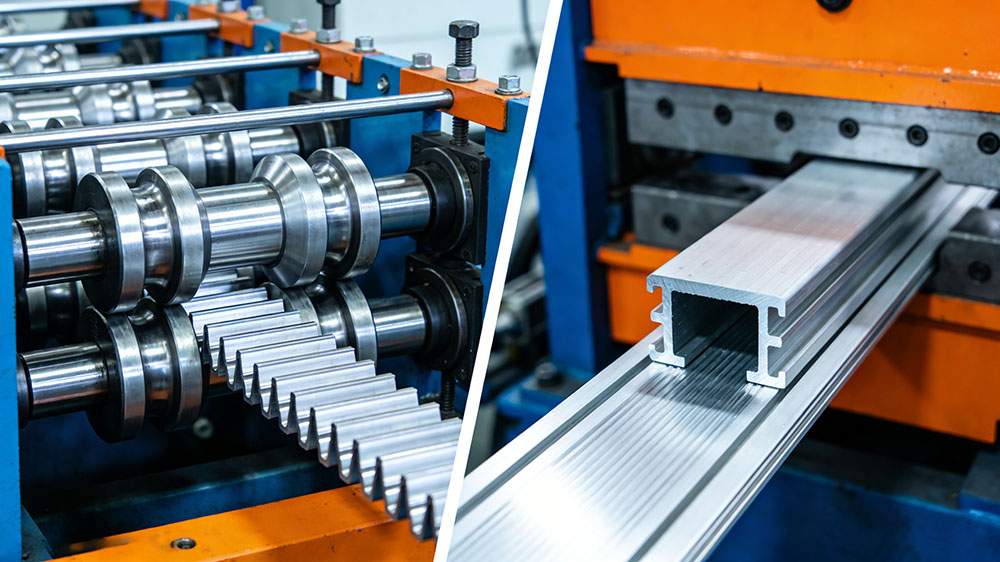
This blog will explore the main advantages of roll forming and extrusion forming, helping you make the best manufacturing decisions based on your project needs.

What is Roll Forming vs. Extrusion Forming?

Roll forming and extrusion forming are both manufacturing processes used to produce continuous profiles with uniform cross-sections, but they differ significantly when examined from multiple perspectives such as forming principle, material behavior, design flexibility, cost structure, and application focus.

Roll forming is a continuous bending process. A flat metal strip passes through a series of roller stations, each progressively shaping the material until the final profile is achieved. The material is gradually formed through controlled deformation at room temperature. In contrast, extrusion forming works by forcing heated material through a specially designed die under high pressure. The material flows plastically through the die opening and emerges in the desired cross-sectional shape.

From a material behavior standpoint, roll forming is typically a cold-forming process, which means the material retains its original thickness and may experience work hardening. The grain structure is elongated along the forming direction. Extrusion, on the other hand, usually involves hot forming. The elevated temperature allows the material to recrystallize and flow more uniformly, often resulting in improved internal structural consistency. Because of this, extrusion can handle more complex internal geometries than roll forming.

Overall, roll forming is best suited for long, thin-walled steel profiles produced in large volumes with consistent thickness, while extrusion is more suitable for complex, precision profiles—especially in aluminum—where design flexibility and cross-sectional complexity are key priorities.

What Materials Are Suitable for Roll Forming?

High-Strength Steel

These materials offer up to 800 MPa of strength, making them suitable for lightweight structural frames and high-strength applications. Due to their high strength and durability, these materials are widely used in the automotive, construction, and other load-bearing industries.

Pre-painted/Galvanised Coils

These materials are pre-coated with anti-corrosion layers, eliminating the need for additional coating processes. They are commonly used for exterior or corrosion-resistant applications like building facades and car body structures.

Aluminum

Aluminum is lightweight, corrosion-resistant, and easy to process, making it ideal for applications in solar panel frames, automotive lightweighting, and aerospace industries.

Stainless Steel

Due to its excellent corrosion resistance, stainless steel is used in industries such as food processing, medical equipment, and kitchen appliances. It is especially valuable in industries that require stringent hygiene standards.

Copper

Known for its excellent conductivity and thermal properties, copper is suitable for precise electrical busbars and piping applications. Its good machinability and conductive properties make it widely used in the electrical industry.

Why Choose Roll Forming?

High Production Efficiency

Roll forming is a continuous process, allowing for high-speed production of long profiles. Compared to extrusion forming, roll forming offers higher production speeds, making it particularly suitable for projects with high-volume production needs.

Lower Production Costs

The equipment for roll forming is simpler and can run continuously for long periods, reducing downtime and labor input. As a result, production costs are lower compared to extrusion forming, which requires more complex molds and equipment. This makes roll forming particularly cost-effective for large-scale production.

Higher Material Utilization

Roll forming minimizes material waste, ensuring maximum material utilization. This reduces scrap, making the process more cost-efficient. Extrusion forming may result in more material loss, especially when producing complex shapes.

Ideal for High-Volume Production

Roll forming is especially suited for high-volume production of standardized products, particularly long profiles and stable shapes. It can offer faster production speeds and more consistent product quality than extrusion forming, especially for projects with high-frequency production needs.

Lower Equipment and Maintenance Costs

Roll forming equipment is typically simpler and more durable than extrusion forming equipment. As the process is straightforward, maintenance needs are lower, reducing downtime and maintenance costs over time.

Better Product Consistency and Stability

Roll forming offers excellent process stability and product consistency, making it ideal for producing long profiles with consistent shape and dimension. The ability to precisely control the rollers ensures high uniformity, particularly for batch production.

In What Situations is Roll Forming Applied?

Construction Industry

Roll forming is widely used in the construction industry, particularly for producing metal roofing sheets, wall panels, and window frames. Its high efficiency and low cost make it ideal for producing long profiles, pipes, and other construction materials in large quantities.

Automotive Industry

Roll forming is used to produce automotive body steel, structural frames, and wheel rims. Given that the automotive industry requires large-scale production and stable product quality, roll forming’s efficiency and low waste rate make it a preferred method for manufacturing automotive parts.

Steel and Machinery Industry

Roll forming is used in the steel and machinery industries to produce various metal profiles like I-beams, channels, and angle bars. It is efficient for processing long profiles and is widely used for manufacturing industrial equipment frames and supports.

Home Appliance Industry

Roll forming is widely applied in the home appliance industry, especially in the production of casings and components for air conditioners, refrigerators, washing machines, etc. The high production efficiency and low cost make it a key manufacturing process for home appliance manufacturers.

Energy Industry

Roll forming is also applied in the energy industry, particularly for producing solar panel frames and wind turbine supports. For products that require high-scale production and stability, roll forming is an ideal solution.

What to Consider When Choosing Roll Forming?

Material Type and Suitability

Roll forming is suitable for a range of metals like steel, aluminum, stainless steel, and copper. However, different materials have varying degrees of formability and processing characteristics. Ensure that the selected material is suitable for the roll forming process, such as aluminum alloys, which are well-suited for this method due to their excellent formability and lighter weight.

Shape and Complexity

Roll forming is best suited for producing simple, stable shapes like straight profiles, channels, and U-shapes. If the product design involves complex geometries or internal features, roll forming might not be ideal. Ensure that the required profile shapes are relatively simple and can be achieved through progressive roller deformation.

Production Volume and Efficiency

Roll forming is optimal for high-volume production, particularly for long profiles or standardized products. When considering roll forming, ensure that the production volume is sufficiently high to justify the process’s efficiency. If the production volume is smaller, other processes may be more suitable.

Precision and Surface Quality Requirements

While roll forming provides good consistency and stability, it may not meet the highest precision and surface quality standards. For products with strict dimensional tolerances or high surface finishes, roll forming may not be as precise as extrusion forming.

Equipment and Mold Costs

Roll forming equipment is relatively simple and suitable for mass production, but initial mold and equipment costs may be high. When selecting roll forming, weigh the equipment investment against the expected production volume. For long-term, large-scale production, roll forming’s mold and equipment costs are often more economical.

Material Thickness and Width

Roll forming works best within a certain range of material thickness, typically from 0.3mm to 8mm. For very thick or thin materials, the process may need adjustments, or other methods might be better suited.

Waste and Material Utilization

Roll forming has a low waste rate, making it ideal for production processes that aim to optimize material usage. When choosing roll forming, expect minimal material waste, which can help lower production costs.

Cost-Effectiveness Analysis

Roll forming generally offers lower production costs, particularly in large-scale production. Ensure that the process maximizes cost-effectiveness, particularly when aiming to reduce production costs, increase throughput, and shorten lead times.

Conclusion

The choice of which forming process to use ultimately depends on your production needs, product shape, material selection, cost control, and quality requirements. Understanding the differences and advantages between roll forming and extrusion forming will help you make a more informed decision, ensuring that your production process achieves the best efficiency and results.

METOFORM offers advanced roll forming machines capable of solving any challenges you may face in this area. Visit our product page to find solutions that meet your specific needs.

Roll Forming vs. Extrusion Forming

FAQs

Q Why is roll forming more suitable for structural steel processing than extrusion forming?

Roll forming is 5-10 times more efficient than extrusion forming, as it can provide unlimited length, a speed of up to 120 meters per minute, and a waste rate of less than 1%. This high efficiency makes roll forming ideal for large-scale structural steel production, reducing production costs and time.

Q Can roll forming produce complex profiles like extrusion forming?

Yes, modern 24-station production lines allow roll forming to produce multi-bend, embossed, and stamped profiles with precision comparable to extrusion molding. This makes roll forming suitable for not only simple profiles but also more complex shapes.

Q What is the minimum production volume for roll forming?

A production volume of 50,000 meters per year justifies the use of dedicated molds. For lower production volumes, hybrid production lines with box-type molds can be used to meet small-batch needs.

Q How does surface quality differ?

Roll forming with pre-coated materials can provide a flawless surface, while extrusion forming typically requires anodizing or painting treatments for surface finishing.

Q Is roll forming limited to steel?

No, roll forming can also process aluminum, stainless steel, and copper, with speed maintained by adjusting the roller gaps.

Q Can roll forming produce hollow profiles?

Yes, roll forming can create closed profiles through in-line lock seam welding without wasting material.

Q How quickly can new profiles be launched?

Using digital roll forming engineering technology, new profiles can be designed and produced in 4-6 weeks, making roll forming highly adaptable in fast-changing markets.

How can we assist you?

Tell us a bit more so we can route your request to the right expert.

    Sign Up For Our Newsletter

    Subscribe to our newsletter for product promos, news, and more.