How Long Do Metal Roofs Last?
Purchasing a metal roof represents a long-term investment. Many property owners look only at color samples during the selection process, assuming the vibrant shade will remain unchanged forever. However, every metal roof exposed to outdoor elements experiences color shifts over time.
Property owners who grasp the science of fading and the exact terms of their warranty save themselves from devastating financial surprises.
Why Metal Roof Colors Fade Over Time?
Metal roof fading is not a manufacturing defect. It is the result of irreversible physical and chemical reactions. Solar radiation serves as the primary driver of this process.
High-energy ultraviolet rays from the sun attack the chemical bonds within the paint finish. Over the years, these molecular bonds break apart, degrading the coating and causing the color to become lighter or duller.
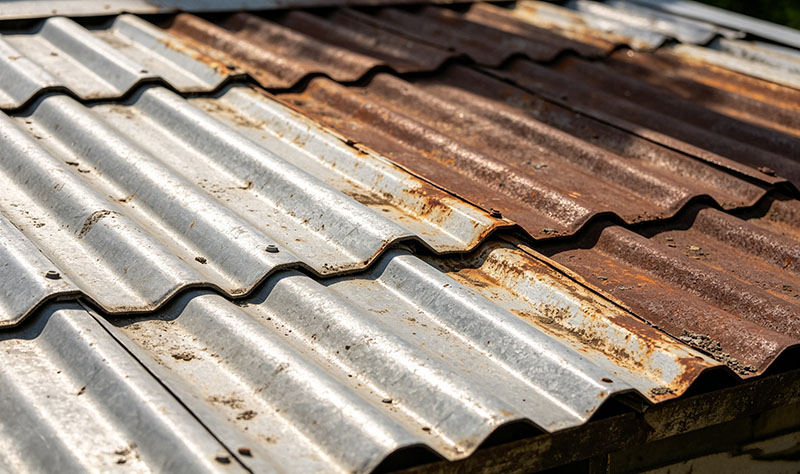
Environmental pollutants accelerate this degradation. Properties located near coastline environments face high salt concentrations and moisture that corrode the paint finish.
For properties in industrial zones or large cities, acid rain acts as a persistent corrosive agent that slowly eats away the top surface.
What is Metal Roof Chalking?
During this degradation process, a white, chalk-like powder often forms on the roof surface. Roofers and manufacturers refer to this powder residue as chalking.
Many people confuse chalking with fading, but they are distinct issues. Fading occurs when ultraviolet rays destroy the pigment molecules, changing the actual color.
Chalking occurs when the resin matrix protecting those pigments breaks down, causing detached molecules to migrate to the surface as white powder.
Testing this condition involves wiping the roof surface with a damp cloth. If white residue transfers to the cloth, exposing a brighter color underneath, the issue is chalking. If wiping yields no residue and the appearance remains dull, the paint has faded completely.
How to Measure Color Fading on Metal Panels
When property owners notice severe color changes and want to file a claim, human eyes are insufficient. Manufacturers reject subjective opinions. The industry relies on a strict quantitative standard to evaluate color degradation.
The Measurement Standard of ΔE
Color science uses a specific unit known as ΔE, written mathematically as ΔE, to measure color variations. ΔE calculates the distance between two distinct colors within a three-dimensional color space.
Human vision possesses high sensitivity to color shifts. Trained professionals notice a difference when the value reaches 1. Average individuals detect a clear contrast when the value rises between 2 and 3.
How Manufacturers Evaluate Fading Claims
To evaluate color degradation, technicians utilize a specialized optical instrument called a spectrophotometer. They obtain a baseline reading from an original color sample stored away from light, or they measure a hidden, fully shaded section of the roof.
The technician then measures the sun-exposed sections of the metal panels. Subtracting the baseline value from the sun-exposed value yields the actual ΔE change.
What Is the Fading Threshold for a Valid Claim?
Most metal panel manufacturers specify exact ΔE limits inside their finish performance contracts. For premium finishes, manufacturers guarantee that color shifts will not exceed 5 ΔE units over a 20-year or 30-year duration.
A shift of 5 units represents a distinct visual transformation, but it remains within an acceptable, uniform range. If a roof registers a value beyond this threshold, such as a 7 or a 10, the manufacturer categorizes the change as abnormal fading and initiates the coverage process.
Fading Coverage on Metal Panel Warranties
Not every instance of color loss qualifies for compensation. The chemical formulation of the paint and the specific exclusions listed in the contract dictate whether a owner receives replacement panels or pays for repairs out of pocket.
Performance Gaps Between PVDF and SMP Coatings
The market relies primarily on two coating types: Polyvinylidene Fluoride, known as PVDF, and Silicone Modified Polyester, known as SMP.
PVDF finishes feature incredibly resilient molecular bonds that resist ultraviolet damage. Consequently, these contracts offer extensive protection, promising that color shifts will remain below 5 ΔE units for 20 to 30 years.
Conversely, SMP coatings cost less but offer lower resistance to long-term weathering.
SMP contracts carry shorter durations, and the allowed ΔE variance is higher, often permitting shifts up to 8 units. Consequently, an SMP roof can look severely altered while remaining within the legal limits of the manufacturer contract.
Common Exceptions That Void Coverage
Even when color measurements exceed the contract threshold, manufacturers deny claims under specific circumstances:
- Harsh Environments: The roof sits inside a highly corrosive industrial zone or too close to a saltwater coastline.
- Poor Maintenance: The owner allows leaves, debris, or mold to accumulate on the panels for extended periods, creating localized acid accumulation that destroys the finish.
- Mechanical Damage: Scratches occurring during installation or cleaning expose the underlying steel, causing rust that lifts the surrounding paint.
Reducing the Visual Impact of Fading
Property owners highly sensitive to visual changes can minimize future aesthetic issues during the initial purchasing phase by choosing specific colors.
Why Light Colors Stand Up Best to Fading
White, beige, and light gray shades represent the top options for minimizing visible fading.
Light finishes possess high solar reflectance. They absorb less heat, keeping surface temperatures lower and slowing down the chemical aging of the paint.
Additionally, because these shades sit close to white originally, pigment degradation creates minimal visual contrast, making the color loss difficult to notice.
Vibrant Tones to Avoid
Bright red, deep blue, dark green, and highly saturated custom colors show fading rapidly. These specific pigment molecules experience faster breakdown under ultraviolet exposure.
Because these shades start with high color saturation, the transition to a washed-out appearance looks uneven and highly noticeable.
Matte versus Gloss Finishes
High-gloss surfaces look premium immediately after installation. However, solar exposure and chalking quickly destroy the shine, creating an uneven, patchy matte appearance. Selecting a matte finish from the beginning eliminates this drastic visual drop as the roof ages.
How Do You Protect Your Metal Roof From Fading?
While owners cannot stop the sun from shining, proper care adds years of vibrant color to a metal roof.
Regular washing provides the simplest protection. Owners should rinse the panels thoroughly with clean water annually, focusing on removing salt, bird droppings, and industrial pollutants that collect near the eaves and trim.

If severe chalking develops, owners must avoid aggressive scrubbing with harsh acidic or alkaline chemical cleaners, as these substances destroy the remaining protective topcoat.
The correct approach involves hiring professional coating restoration teams to apply specialized fluoropolymer field-applied paints, adding over a decade of fresh color performance to aging panels.
When preparing to select a metal roof for a new project, avoiding hours spent stressing over maintenance manuals and contract text makes sense. Transfer the burden to professionals. Contact metoform today to request physical metal panel samples or to receive a comprehensive project estimate.


How can we assist you?
Tell us a bit more so we can route your request to the right expert.
Sign Up For Our Newsletter
Subscribe to our newsletter for product promos, news, and more.