
5 Reasons to Choose Light Gauge Steel Framing
Choosing the right framing material affects a construction project’s cost, schedule, and long-term performance. As labor shortages and tight deadlines become more common, many contractors are considering alternatives to conventional framing methods.
Light gauge steel (LGS), also known as cold-formed steel (CFS), is one such option. Made from galvanized steel coils, LGS components are dimensionally consistent, versatile, and well suited to automated production.
LGS is used in residential and commercial buildings, as well as modular and prefabricated construction. Its growing use reflects the industry’s interest in more efficient and predictable building methods.
This article looks at five practical reasons to consider LGS framing and explains how automated steel framing machines can support its production.
What Is Light Gauge Steel Framing?
Light gauge steel framing uses thin-walled steel profiles, typically formed into C-shaped studs, U-shaped tracks, joists, and other structural components.
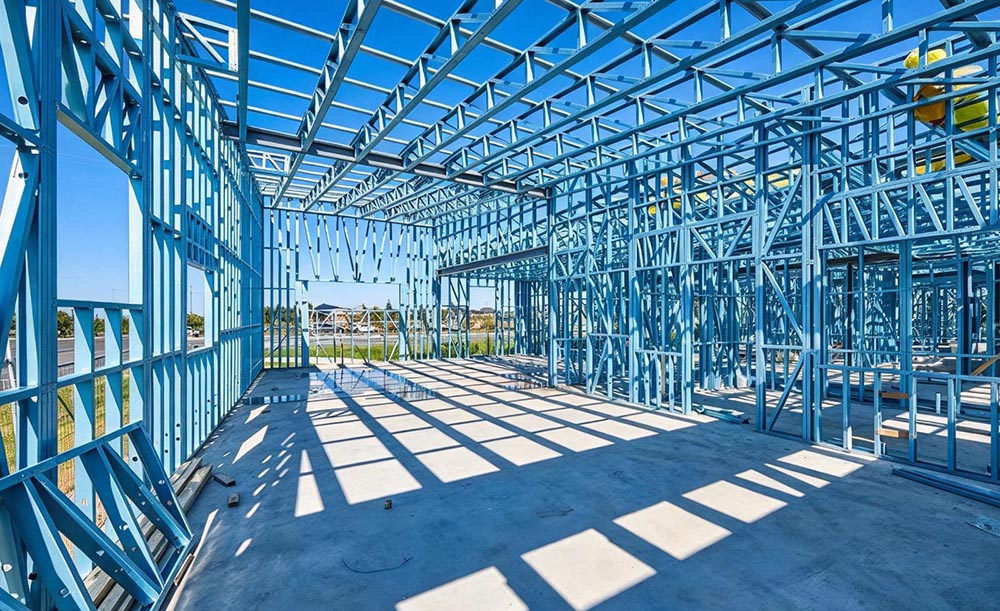
These profiles are manufactured through a cold roll forming process, in which galvanized steel passes through a series of rollers to achieve the required shape without heating the material to hot-rolling temperatures.
LGS framing can be used for load-bearing walls, non-load-bearing partitions, floor systems, and roof structures when properly engineered.
Because the components can be manufactured to precise dimensions, LGS is particularly suitable for prefabricated and modular construction.
Faster Construction and More Predictable Schedules
Construction delays often result from weather conditions, material handling, labor availability, and unexpected onsite adjustments.
Light gauge steel framing helps address these challenges by moving much of the component manufacturing process into a controlled factory environment.
Instead of measuring and cutting every framing member onsite, manufacturers can produce steel studs, tracks, and joists according to approved design specifications.
Key advantages include:
- Reduced onsite measuring and cutting
- Consistent component dimensions
- Faster assembly of prefabricated wall and floor systems
- Less rework caused by framing inaccuracies
- Better coordination between factory production and site preparation
For example, steel wall framing components can be manufactured while contractors complete foundation work. Once the site is ready, the framing materials can be delivered for assembly.
This parallel workflow can help shorten project schedules and reduce delays associated with traditional sequential construction.
Actual time savings depend on project complexity, logistics, and installation planning.

Reduced Onsite Labor Requirements
Skilled labor shortages are a continuing challenge for construction companies.
Traditional framing often involves extensive onsite measuring, cutting, drilling, and assembly. These activities require time and experienced workers.
Prefabricated LGS framing reduces some of these requirements by shifting repetitive manufacturing tasks into an automated production facility.
Modern light gauge steel framing machines can manufacture profiles with predefined lengths, service holes, and connection features.
This allows installation teams to focus more on assembling prepared components rather than fabricating individual members in the field.
For contractors, the benefits may include improved labor productivity, more predictable installation workflows, and reduced dependence on extensive onsite fabrication.
Skilled supervision and proper installation remain essential, but automated manufacturing helps simplify many repetitive tasks.
Greater Design Flexibility and Structural Versatility
Light gauge steel framing supports a wide range of building designs and applications.

Its high strength-to-weight ratio allows engineers to develop efficient framing systems while keeping individual components relatively lightweight.
LGS framing is commonly used in:
- Residential buildings: Single-family homes, townhouses, and multi-unit housing
- Commercial buildings: Offices, hotels, schools, and retail facilities
- Modular construction: Prefabricated rooms, portable buildings, and modular housing units
- Interior partitions: Lightweight framing for non-load-bearing walls
- Floor and roof systems: Engineered steel joists, trusses, and supporting members
Another advantage is dimensional stability.
Unlike wood, steel does not absorb moisture and undergo the associated swelling, shrinking, or warping. This helps manufactured components maintain consistent dimensions during normal building conditions.
For prefabricated construction, dimensional consistency is especially important because separate components must fit together accurately during assembly.
However, all structural applications must be engineered for the required loads, connections, and applicable building codes.
Better Cost Control and Long-Term Value
Construction costs involve more than the purchase price of framing materials.
Labor, transportation, waste, installation time, and future maintenance can all influence the total project cost.
Although light gauge steel is not always the least expensive material upfront, it can offer cost advantages when the entire construction process is considered.
Lower Onsite Fabrication Costs
Prefabricated steel components reduce the amount of measuring, cutting, and drilling required at the job site.
This can help contractors improve labor efficiency and reduce unnecessary material handling.
Reduced Material Waste
Automated roll forming machines manufacture profiles according to specified lengths and configurations.
With effective production planning, manufacturers can reduce avoidable cutting waste and improve steel coil utilization.
Improved Production Consistency
Computer-controlled forming processes help maintain repeatable dimensions across production batches.
Consistent components can reduce the risk of costly assembly adjustments.
Long-Term Durability
Steel is resistant to termite damage and biological decay. Properly specified protective coatings also help manage corrosion risks.
These characteristics may reduce certain maintenance concerns compared with alternative framing materials.
For developers and manufacturers, the financial value of LGS construction should be evaluated based on total project costs rather than material prices alone.
Improved Material Efficiency and Sustainability
Environmental performance is becoming an increasingly important consideration in construction.
Light gauge steel framing offers several characteristics that support resource-efficient building practices.
Recyclable Material
Steel can be recycled repeatedly, making it a valuable material for circular manufacturing and construction systems.
Reduced Manufacturing Waste
Automated production allows manufacturers to optimize profile lengths and reduce unnecessary offcuts.
Efficient Transportation
The relatively low weight of many LGS framing components can simplify handling and transportation compared with heavier structural alternatives.
Compatibility with Offsite Construction
Factory-based manufacturing provides greater control over material use, inventory, and waste collection.
However, sustainability depends on the complete building lifecycle, including steel production, transportation, energy use, and end-of-life recovery.
Light Gauge Steel vs. Traditional Wood Framing
The following comparison highlights several practical differences.
| Factor | Light Gauge Steel Framing | Traditional Wood Framing |
| Dimensional stability | Resistant to moisture-related warping | Can shrink, swell, or warp |
| Pest resistance | Not susceptible to termites | Requires appropriate pest protection |
| Fire characteristics | Steel is noncombustible | Wood is combustible |
| Prefabrication | Well suited to automated production | Also suitable for factory prefabrication |
| Material recycling | Steel is recyclable | Wood can be reused or recycled depending on condition |
| Manufacturing accuracy | Consistent machine-formed profiles | Depends on material quality and fabrication |
| Cost | Depends on design, labor, and local supply | Depends on lumber prices and local labor |
Both systems can perform effectively when properly designed and installed. The best choice depends on project requirements, local regulations, material availability, and overall costs.
How Automated LGS Framing Machines Improve Manufacturing Efficiency
The advantages of light gauge steel construction depend partly on how accurately and efficiently the framing components are produced.
An automated steel framing roll forming machine converts galvanized steel coils into finished profiles through a continuous production process.
Typical operations include coil feeding, leveling, punching, roll forming, cutting, and component identification.
By integrating these operations, manufacturers can reduce manual processing and produce consistent framing components for different building projects.
Automation also makes it easier to manufacture multiple profile sizes when equipment supports automatic adjustments.
For companies producing prefabricated wall panels, floor systems, or modular building components, flexible manufacturing equipment can improve production planning and reduce changeover time.
How Metoform Supports Light Gauge Steel Construction
At Metoform, we specialize in automated roll forming equipment designed to help manufacturers produce light gauge steel framing components efficiently and accurately.
Our solutions support residential construction, commercial framing, and prefabricated building applications.
LG89/100/140/150 Light Gauge Steel Framing Machine
The Metoform MF200 manufactures CC steel profiles for structural framing applications.
Its automatic operation eliminates manual tooling changes within the supported range. Integrated punching and cutting functions help streamline production and prepare components for assembly.
It is designed for fixed single specification, with fewer parameter adjustments. Workers can master operation quickly, lowering the risk of setup errors.

MF1600 Multi-Profile Steel Framing Machine
The Metoform MF1600 is a fully automatic cold roll forming system designed for flexible steel framing production.
It supports profile widths from 75 mm to 160 mm and galvanized steel thicknesses up to 1.6 mm.
Its automatic adjustment capabilities help manufacturers reduce setup time when producing different supported framing sizes.
These features make the MF1600 suitable for prefabricated residential and light commercial framing production.

How to Choose the Right LGS Framing Machine
Before investing in steel framing equipment, manufacturers should evaluate their production requirements carefully.
Important considerations include profile dimensions, material thickness, required production capacity, punching capabilities, software compatibility, and technical support. Contact our team if you need professional consultation.
A machine that matches your product range and expected production volume can help improve manufacturing efficiency and support future business growth.
Conclusion
Light gauge steel framing can make construction more efficient, especially when the components are produced in a controlled factory environment. Accurate steel profiles are easier to assemble, and prefabrication can reduce the amount of measuring, cutting, and adjustment required on site.
Metoform manufactures automated machines for producing light gauge steel framing components. Our equipment is suitable for companies making steel studs, tracks, joists, and other profiles for residential, commercial, and prefabricated construction.
Learn more about our Light Gauge Steel Framing Machines or contact Metoform to discuss your project.
FAQs
What is light gauge steel framing?
Light gauge steel (LGS) framing uses thin galvanized cold-formed steel profiles including studs, tracks, and joists for residential, commercial, and modular building structures.
Is light gauge steel better than wood framing?
LGS features better dimensional stability, termite resistance, and noncombustible performance. The final choice depends on project budget, codes, and construction goals.
What machine produces light gauge steel framing?
Automated cold roll forming machines produce LGS profiles, with integrated feeding, punching, forming, and cutting for high-volume prefab manufacturing.

Product Recommendation


How can we assist you?
Tell us a bit more so we can route your request to the right expert.
Sign Up For Our Newsletter
Subscribe to our newsletter for product promos, news, and more.