How to Choose a Purlin Roll Forming Machine: A Buyer’s Decision Guide
Choosing a purlin roll forming machine involves more than comparing specifications. The required profile, material thickness, punching configuration, and expected production capacity all play a role in determining the right solution.
A machine that is not properly matched to your production needs can lead to unnecessary constraints, reduced efficiency, and higher operating costs over time.
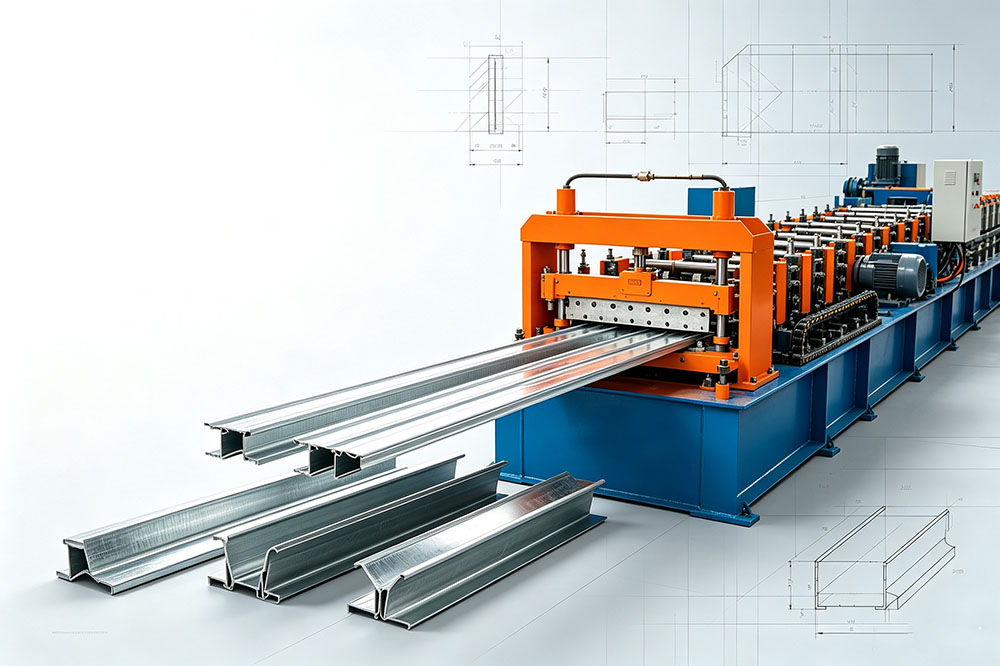
Metoform has supplied purlin roll forming lines to steel structure manufacturers in markets around the world. This guide explains the key factors to consider when selecting a machine, helping you make an informed decision based on practical production requirements rather than marketing claims.
C, Z, or CZ: Which Purlin Profile Does Your Project Need
C Purlins
C-shaped purlins have a flat web with two equal flanges on the same side. They are symmetric when viewed from the end.
Builders use C purlins for wall girts, short-span roof sections, and mezzanine floor framing. The open side faces the cladding or decking.
Z Purlins
Z-shaped purlins have flanges that point in opposite directions. They look like a letter Z from the end. They are stronger in bending than C purlins of the same gauge and depth. They are the standard choice for long-span industrial roofs.
Z purlins can also be nested and overlapped at the supports. This creates a continuous beam effect across multiple bays, which saves steel weight.
CZ Interchangeable Machines
A CZ interchangeable machine can produce both C and Z profiles without changing the roller tooling. The operator selects the profile on the control panel.
This is the most flexible option. You can switch between C and Z on the same shift to fill a mixed order. The trade-off is a higher upfront machine cost.
What a Purlin Roll Forming Machine Actually Does
A purlin roll forming machine starts with a coil of galvanized steel strip. The strip feeds through a series of roller stations. Each station bends the steel a little more than the previous one.
By the time the steel exits, it has been formed into a precise C, Z, or U profile. The entire process happens at room temperature. No heat is applied.
In-line punching adds holes for bolts, bracing, and service runs while the steel is still moving through the line.
A hydraulic cutoff saw slices each purlin to the exact length called for in the production plan. The result is a stack of labeled, cut-to-length purlins that go straight from the machine to the truck or the building site.
Key Machine Specs and What They Mean for Your Output
Gauge Range
Most purlin machines handle 1.5mm to 3.0mm galvanized steel. Some heavy-duty models go up to 4.5mm.
Thicker steel requires more forming stations and a stronger frame. If your market calls for heavy industrial purlins, do not buy a machine rated only for light gauge.
Profile Depth Range
Common depth ranges go from 80mm to 300mm. Some machines can produce purlins up to 350mm or 450mm deep.
Wider depth range means more tooling stations and a longer machine bed. It also means the machine can serve a bigger variety of building projects.
Production Speed
Speed is measured in meters per minute. A typical machine runs at 10 to 20 meters per minute. Faster machines cost more. The question is whether your order volume justifies the extra speed. If you are running one shift a day with no backlogs, standard speed works fine.
Interchangeable vs. Dedicated Machines: The Real Trade-offs
A dedicated C purlin machine produces only C profiles. Setup is faster. The machine costs less. Maintenance is simpler. If your business only sells C purlins, this is the obvious choice.
A dedicated Z purlin machine is the same idea for Z profiles only. Lower cost, simpler operation, no changeover time.
A CZ interchangeable machine gives you both profiles in one line. The changeover between C and Z takes a few minutes on an automatic system. You lose some production time during the switch, but you gain the ability to fill mixed orders from a single machine.
The hidden cost of a dedicated machine is the lost business from customers who need the other profile. If a builder calls and asks for Z purlins and you only run C, they will call someone else.
That lost margin adds up faster than the price difference between a dedicated and interchangeable machine.
Why In-Line Punching Matters for Modern Steel Framing
Older purlin production lines ran the formed purlin through a separate punching station. This added a second handling step, required separate tooling, and introduced alignment errors.
Modern machines punch the steel while it is still flat or during the forming process. Web holes, flange holes, and bracing slots are all produced in the same pass.
The advantages are threefold. First, production speed goes way up because there is no second operation. Second, hole positions are more accurate because they are punched before or during forming, not on a finished profile that can shift in the fixture.
Third, you can offer more value to your customers. A purlin with pre-punched bolt holes saves them hours of on-site drilling.
Production Speed, Gauge Range, and Material Handling
Speed and gauge are linked. Running 3.0mm steel at 20 meters per minute takes a lot more power and a much sturdier machine frame than running 1.5mm at the same speed.
Ask the manufacturer for the speed-at-gauge chart. Do not just look at the headline speed number. That number is almost always for the thinnest gauge the machine handles.
Material handling at both ends also matters. A powered decoiler at the infeed keeps the steel strip under consistent tension.
A run-out table at the outfeed with automatic stacking catches the finished purlins without manual labor. These are not extras. They are what makes the line productive across a full shift.
Questions to Ask Before Buying a Purlin Roll Forming Line
What profiles do my customers actually order? If 90 percent of your orders are C purlins, a dedicated C machine may be the better investment.
What is the thickest gauge my market uses? Do not buy a 2.5mm machine if your region builds with 3.0mm purlins.
How many profile sizes do I need? A machine that changes profile depth automatically saves hours of manual adjustment time between batch runs.
What hole patterns do my customers want? Pre-punched holes for specific bolt sizes and spacings. Bracing slots. Service holes. Make a list of the top five punching requirements before comparing machines.
What is the total cost of ownership? Include spare roller sets, tooling changes, annual maintenance, operator training, and the cost of downtime.
Compare Metoform purlin roll forming machine options with detailed spec sheets for C, Z, and CZ interchangeable models.
Where C and Z Purlins Are Used in Real Buildings
- Industrial warehouses: C purlins for wall girts. Z purlins for roof spans of 6 to 12 meters or more.
- Factory buildings: Z purlins overlapped at the supports for continuous beam action across wide bays. C purlins for side cladding supports.
- Commercial buildings: Prefabricated steel structures with Z purlin roof systems and C purlin wall framing.
- Agricultural buildings: Long clear-span roofs with Z purlins. C purlins for equipment platform supports and mezzanine floors.
- Temporary and modular structures: Light-gauge C purlins for quick-assembly frames. Z purlins where wind uplift is a concern.

Metoform Purlin Roll Forming Solutions
Metoform builds purlin roll forming machines for C, Z, and CZ interchangeable production in gauge ranges from 1.5mm to 4.5mm.
Every machine includes in-line hydraulic punching for web and flange holes, automatic profile depth switching, and integrated coil handling. We provide operator training, installation support, and ongoing technical service worldwide.
Frequently Asked Questions
Q1 What is the difference between C and Z purlins?
C purlins have flanges on the same side. Z purlins have flanges on opposite sides. Z purlins are stronger in bending and can be overlapped at supports for continuous beam action. C purlins are simpler and commonly used for wall girts and short spans.
Q2 Can one machine produce both C and Z purlins?
Yes. CZ interchangeable machines can switch between C and Z profiles without changing roller tooling. The changeover on automatic systems takes a few minutes.
Q3 How thick can a purlin roll forming machine handle?
Standard machines handle 1.5mm to 3.0mm galvanized steel. Heavy-duty models go up to 4.5mm. Check the specific gauge rating before ordering.
Q4 What is in-line punching and do I need it?
In-line punching adds bolt holes and bracing slots while the steel moves through the roll forming line. If your customers expect pre-punched purlins, you need this capability. It eliminates a separate secondary operation.
Q5 How fast does a purlin roll forming machine run?
Typical speeds are 10 to 20 meters per minute. Speed depends on steel gauge and profile complexity. Ask for the speed-at-gauge chart, not just the headline number.
Q6 Where can I get a purlin roll forming machine with technical support?
Metoform manufactures C, Z, and CZ interchangeable purlin roll forming machines with in-line punching and automatic profile switching. Training, installation, and ongoing support are included.
Explore purlin roll forming machinesExplore purlin roll forming machines
Contact Metoform for a quoteContact Metoform for a quote

Product Recommendation


How can we assist you?
Tell us a bit more so we can route your request to the right expert.
Sign Up For Our Newsletter
Subscribe to our newsletter for product promos, news, and more.