
Why Rack Manufacturers Are Bringing Production In-House
Every warehouse, distribution center, and big-box retail store runs on steel racking. The uprights, beams, and bracing that hold tens of thousands of pallets are produced by the millions of tons every year.
Most racking companies buy these steel profiles from outside suppliers. They pay a markup on every meter. They wait on someone else’s production schedule. They accept the lead times they are given.
A growing number of rack manufacturers are changing that equation. They are buying roll forming machines and producing their own rack profiles in-house. Metoform builds storage rack roll forming lines for this exact transition.
The Problem: Why Buying Rack Components Costs More Than It Should
A typical rack manufacturer buys steel uprights and beams from a third-party roll former.
The third party charges for the steel coil, the roll forming, the cutting, the punching, the packaging, and the freight. Each of those line items has a margin built in. By the time the profile reaches your loading dock, you have paid 25 to 40 percent more than the raw material and processing cost.
On a project that uses 500 tons of racking steel, that markup represents a six-figure difference. Multiply that across a year of orders and the numbers get hard to ignore.
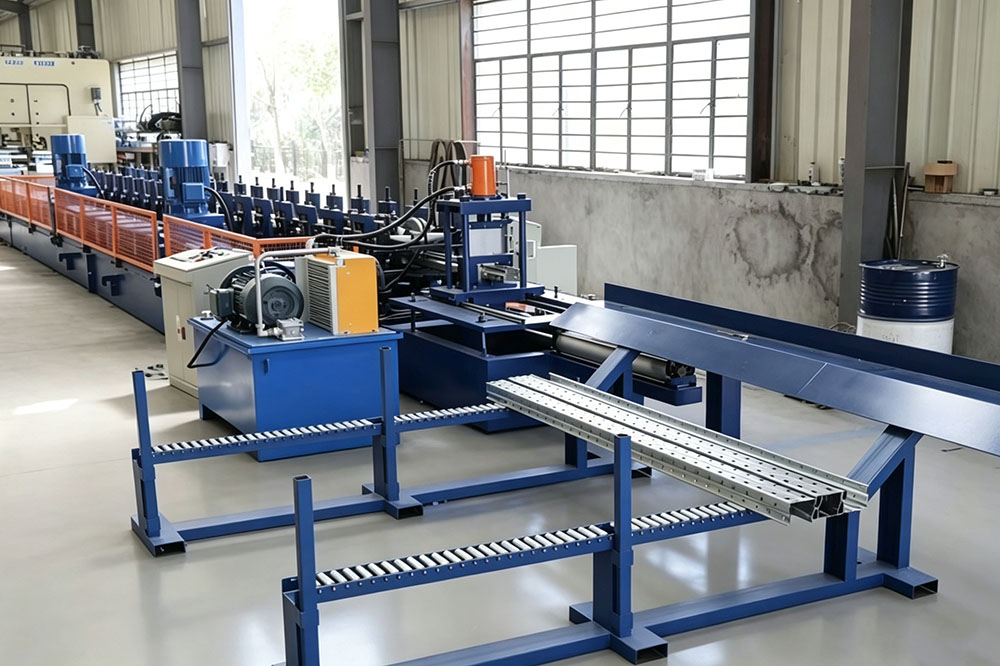
What a Storage Rack Roll Forming Machine Actually Produces
A storage rack roll forming line takes galvanized steel coil and turns it into finished rack components in one continuous process. The machine forms the steel into the required cross-section.
It punches bolt holes, slot holes, and bracing holes while the steel moves through the line. It cuts each piece to the exact millimeter called for in the order.
The output is a bundle of labeled, ready-to-assemble rack components. They go straight from the machine to the welding station or directly into the shipping crate.
The Key Profiles That Make Up a Complete Racking System
Upright columns. The vertical posts that carry the weight of every pallet. These are the heaviest-gauge profiles in the system, typically 1.5mm to 3.0mm steel.
Horizontal beams. The cross-members that pallets sit on. Usually lighter gauge than uprights. Produced in high volumes because every bay needs multiple beam levels.
Bracing and ties. Diagonal and horizontal stabilizers that keep the rack structure square and prevent racking collapse under load. Smaller profiles but produced in large quantities.
Panel supports and decking. Optional but common in pallet rack systems. Flat or ribbed panels that create a solid shelf surface.
From Steel Coil to Finished Rack Component: The Production Flow
- Step one: coil loading. A decoiler feeds the steel strip into the line under controlled tension.
- Step two: punching. A hydraulic or servo-driven punch press creates bolt holes, slot holes, and bracing holes in the flat strip before it enters the forming section.
- Step three: roll forming. A series of roller stations progressively bends the flat strip into the upright, beam, or bracing profile. Cold forming. No heat. No material loss.
- Step four: cutoff. A flying saw slices each piece to the programmed length while the profile keeps moving. No stopping between pieces.
- Step five: stacking. Finished components are collected on a run-out table and stacked for the next operation, which is typically welding of end plates and connectors.
Upright, Beam, or Bracing: Which Profile Needs What Machine
Upright profiles are the most demanding. They require the thickest gauge capability and the heaviest punching. The machine frame needs to be stout enough to maintain profile accuracy at 3.0mm and above.
Beam profiles are lighter gauge but higher volume. The machine runs longer between changeovers. Productivity per shift matters more than maximum gauge capability.
Bracing profiles are the simplest. They use the lightest gauge and rarely need punching beyond a few mounting holes. A separate smaller machine or a quick-change tooling setup on the main line can handle them.
Most rack manufacturers start with an upright and beam line. They buy bracing from outside suppliers until their volume justifies a dedicated bracing machine.
In-House Rack Production: The Numbers at Scale
At 5,000 tons of racking steel per year, buying from outside suppliers might still make sense. The machine payment does not cover the margin spread at that volume.
At 10,000 tons per year, the equation shifts. The margin you are paying the third-party roll former now exceeds the annual cost of owning and operating your own machine.
At 20,000 tons per year, in-house production is clearly cheaper. You control your own schedule. You respond to rush orders without begging for production slots. You keep the margin that used to go to your supplier.
The exact break-even point depends on your local steel coil prices, labor costs, and freight distances. But the pattern is consistent across markets: above a certain volume, owning the machine wins.
Quality Standards Your Buyers Expect
Rack buyers inspect their orders. They check hole positions. They measure profile dimensions. They verify the galvanized coating thickness.
A roll forming machine produces more consistent profiles than traditional stamp-and-bend methods. Every piece comes off the same rollers. Every hole is punched by the same tooling at the same position. The variation from piece to piece is a fraction of a millimeter.
That consistency matters commercially. A rack installer who receives perfectly matching uprights and beams finishes the job faster. Fewer returns. Fewer callbacks. Higher customer satisfaction. These are the intangible benefits that show up in repeat orders.
Three Ways Roll Forming Beats Traditional Rack Manufacturing
- Speed: Roll forming is continuous. No stop-start between pieces. A typical line produces 10 to 20 meters per minute. That is 400 to 800 pieces per shift for a standard beam profile.
- Material efficiency: Roll forming uses nearly the entire coil. Offcut waste is under 2 percent. Stamp and shear processes waste 10 to 15 percent of the steel. At 10,000 tons per year, a 10 percent waste reduction saves 1,000 tons of steel.
- Labor: One operator manages the decoiler. One manages the outfeed. That is two people for the entire line. A traditional manufacturing cell with separate punching, forming, and cutting stations needs three to five operators.
Metoform Storage Rack Roll Forming Solutions
Metoform manufactures storage rack roll forming lines for upright columns, horizontal beams, and bracing profiles in gauge ranges from 1.5mm to 4.0mm.

Every line includes in-line hydraulic punching, automatic length programming, and quick-change tooling for multi-profile production. We provide operator training, installation support, and ongoing service.
Frequently Asked Questions
Q1 What profiles can a storage rack roll forming machine produce?
Upright columns, horizontal beams, diagonal bracing, and panel supports. The specific profiles depend on the roller tooling. Multi-profile machines can switch between upright and beam production with a tooling change.
Q2 How thick can the steel be for rack uprights?
Standard rack roll forming machines handle 1.5mm to 3.0mm galvanized steel. Heavy-duty models go up to 4.0mm for high-bay warehouse applications.
Q3 Does the machine punch holes?
Yes. In-line hydraulic or servo punching adds bolt holes, slot holes, and bracing holes during the forming process. The hole pattern is programmable and changes automatically between batches.
Q4 How many operators do I need?
A fully automated line needs two operators: one at coil loading and one at finished product stacking. Some lines with automatic stacking can run with one operator.
Q5 Can I produce multiple rack profiles on one machine?
Yes. Quick-change tooling allows switching between upright and beam profiles. Some machines include automatic profile width and height adjustment without manual tooling changes.
Q6 Where can I get a storage rack roll forming machine?
Metoform builds storage rack roll forming lines for upright, beam, and bracing profiles. Contact us with your target profiles and annual volume for a machine specification and quote.
Explore storage rack roll forming machines Explore storage rack roll forming machines
Contact Metoform for a quote Contact Metoform for a quote


How can we assist you?
Tell us a bit more so we can route your request to the right expert.
Sign Up For Our Newsletter
Subscribe to our newsletter for product promos, news, and more.