Is a Roof Panel Roll Forming Machine Worth It? A Business Owner’s Guide
Metal roofing is growing. More homeowners, builders, and commercial developers are choosing steel panels over asphalt shingles and clay tiles.
That creates a straightforward business opportunity. Buy a roll forming machine. Produce metal roof and wall panels. Sell them to contractors and builders at a margin.
But the numbers only work if you pick the right machine, the right panel profiles, and the right business model. Metoform builds roof and wall panel roll forming lines for manufacturers worldwide. Here is what you need to think through before you invest.
How Much Revenue One Roof Panel Machine Can Generate
A mid-range roof panel roll forming line can produce 200 to 500 linear meters of finished panel per hour. At an average selling price of $3 to $6 per linear meter, that represents $600 to $3,000 in output per hour.
Run one shift a day, five days a week. Even at the low end of that range, you are producing meaningful revenue. The machine pays for itself in months, not years, if you have steady orders.
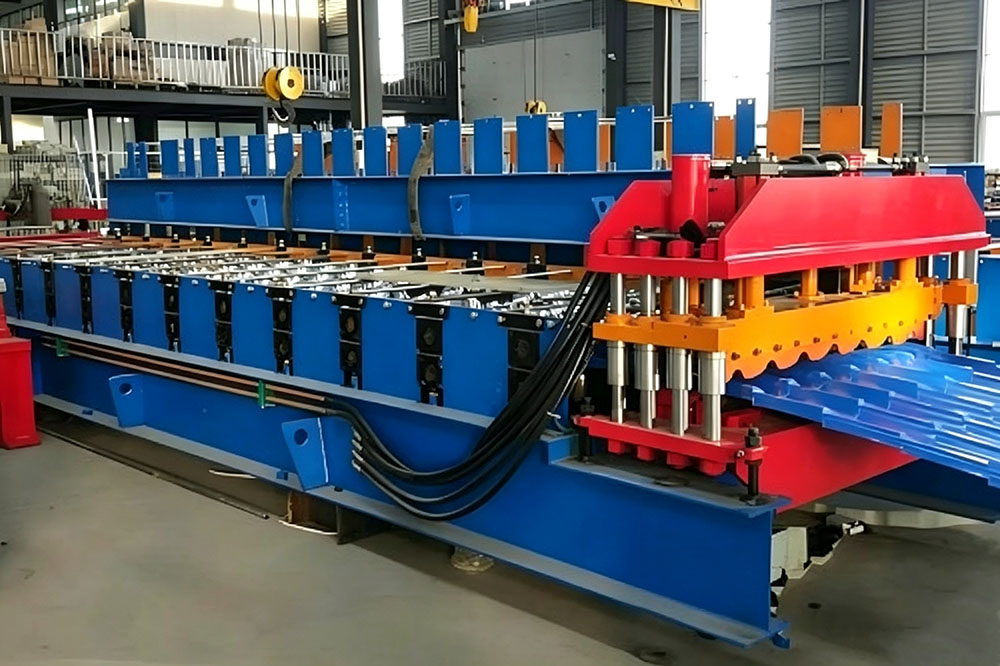
The key variable is not the machine speed. It is your order pipeline. A machine running at half speed with a full order book makes more money than a fast machine sitting idle.
The Five Roof Panel Profiles That Sell Fastest
- Corrugated panels: Wavy profile. Used on agricultural buildings, sheds, and budget residential roofing. Fastest to produce. Highest volume. Lowest margin per linear meter.
- Trapezoidal panels: Flat-bottom ribs with angled sides. Used on commercial and industrial buildings. Better span capability than corrugated.
- Mid-range margin: Standing seam panels. Vertical ribs with concealed fasteners. Used on high-end residential and architectural commercial projects. Highest margin per linear meter. Requires more machine capability.
- Glazed tile profiles: Mimic traditional clay tile in steel. Popular in Asian and Mediterranean markets. Floor decking panels. Used as permanent formwork for concrete floors in steel-frame buildings. Steady demand from commercial contractors.
Standing Seam vs. Corrugated vs. Trapezoidal: Which Market Pays More
Corrugated
Price per linear meter is lower. But production speed is faster. The profit equation is volume times margin. If you have access to a large market of agricultural and budget-conscious builders, corrugated can be very profitable. You sell more meters per shift.
Trapezoidal
Mid-range price. Better structural performance. Buyers expect tighter tolerances and clean edges. This is the volume product for commercial and industrial buildings. It is the bread-and-butter profile for most roof panel manufacturers.
Standing Seam
Highest price per meter. Lowest volume. Customers are pickier about finish quality. A standing seam machine costs more because it needs more forming stations.
But each meter you sell carries roughly double the profit of corrugated. If your market has high-end residential or architectural commercial demand, standing seam is the margin play.
In-House Production vs. Buying Panels: The Cost Gap
Buying finished panels from a distributor costs 30 to 50 percent more than producing them yourself, per linear meter. That difference is the roll former’s margin plus the distributor’s freight and warehousing cost.
A contractor who installs 50,000 linear meters of roofing per year spends $150,000 to $300,000 on finished panels. At a 35 percent cost savings from in-house production, the machine pays for itself in 12 to 24 months.
The break-even point depends on your annual volume. Below roughly 20,000 linear meters per year, buying panels is still cheaper. Above that, the machine starts making financial sense.
What Buyers Actually Care About: Thickness, Coating, and Color
Panel buyers do not care about your machine brand. They care about three things.
- Thickness: Is the steel 0.4mm or 0.6mm? Thicker steel costs more but lasts longer. Most commercial projects specify 0.5mm minimum.
- Coating: Galvanized or galvalume? Pre-painted? The coating determines how many years the panel lasts before it rusts. Galvalume (zinc-aluminum) typically outlasts plain galvanized by 2 to 4 times in coastal environments.
- Color: Does it match the building trim? Buyers will walk away if your color range is limited to three standard shades. A good machine can handle multiple coil colors with quick changeover between batches.
Mobile vs. Fixed-Location Machines: When Portability Pays Off
A fixed-location machine sits in your factory. Trucks bring steel coils in. Trucks take finished panels out. This works when most of your customers are within a 200-kilometer radius.
A mobile machine mounts on a trailer and travels to the job site. It produces panels right next to the building. This eliminates panel transport damage and length restrictions. Panels can be produced in single pieces that run the full length of the roof, with zero seams.
Mobile machines cost more upfront and need a truck to pull them. They make sense for contractors who build in remote areas or need seamless panels longer than a standard flatbed truck can carry.
Three Steps to Start a Roof Panel Production Line
- Step one: Decide on your panel profiles. Pick two or three to start. Do not try to serve every market on day one. Corrugated plus trapezoidal covers 80 percent of the volume in most regions.
- Step two: Secure your steel coil supply. Talk to at least three coil suppliers before ordering the machine. You need to know the lead times, minimum order quantities, and delivered cost per ton for your region.
- Step three: Line up your first five customers before the machine arrives. Do not wait for the machine to arrive and then start selling. The clock is ticking on your return on investment from the day the machine is delivered.
Explore Metoform roof and wall panel roll forming machines for corrugated, trapezoidal, standing seam, and glazed tile profiles.

Mistakes That Eat Into Profit Margins
Buying more machine than your order volume supports. A machine capable of 20 meters per minute does not help if your sales are 5 meters per minute.
Underestimating coil lead times. If you run out of steel, the machine stops. Stopped machines do not generate revenue. Ignoring maintenance.
Rollers wear. Bearings need grease. Cutoff blades need sharpening. A machine that is down for a week waiting for a replacement part has erased a month of profit.
Pricing panels too low to win the first few orders. Discounting to build a customer base trains those customers to expect low prices. Compete on delivery speed and consistent quality instead.
Metoform Roof and Wall Panel Machine Solutions
Metoform manufactures roof and wall panel roll forming lines for corrugated, trapezoidal, standing seam, glazed tile, and floor decking profiles.
Machines are available in fixed-location and mobile configurations with gauge ranges from 0.3mm to 1.2mm. Multi-profile models switch between panel types with quick-change tooling or automatic adjustment. We provide operator training, coil handling systems, and ongoing service.
Frequently Asked Questions
Q1 How much does a roof panel roll forming machine cost?
Entry-level machines for a single profile start around $30,000 to $60,000. Multi-profile lines with automatic changeover cost $80,000 to $150,000 or more depending on features and production speed.
Q2 Which panel profile should I start with?
Start with the profile that your local market buys most. In most regions, that is corrugated or trapezoidal. Add standing seam later when you have steady revenue from the volume products.
Q3 How many operators does a roof panel machine need?
A single-profile line typically needs two operators: one at the infeed managing the coil and one at the outfeed stacking finished panels. Automated stacking systems can reduce that to one operator.
Q4 Can one machine produce multiple panel profiles?
Yes. Multi-profile machines can switch between corrugated, trapezoidal, and standing seam by changing the roller tooling. Some machines offer automatic profile switching without manual tooling changes.
Q5 How long does it take to learn to operate the machine?
Basic operation takes about one to two weeks of training. The operator learns coil loading, machine controls, length programming, and basic troubleshooting. Full proficiency with multiple profiles takes a few months.
Q6 Where can I get a roof panel roll forming machine with support?
Metoform builds roof and wall panel roll forming machines with training, installation, and ongoing technical support. Contact us for machine specifications and a quote based on your target profiles and volume.

Product Recommendation


How can we assist you?
Tell us a bit more so we can route your request to the right expert.
Sign Up For Our Newsletter
Subscribe to our newsletter for product promos, news, and more.