
How to Choose the Right Steel Coil for Your Roll Forming Line
You can buy the best roll forming machine on the market and still produce bad product if the steel coil feeding it is wrong. Coil choice affects surface finish, dimensional accuracy, tooling wear, and how many rejected parts come off the end of the line. This guide covers what to look for in a steel coil supplier and how to match coil specifications to your production needs.
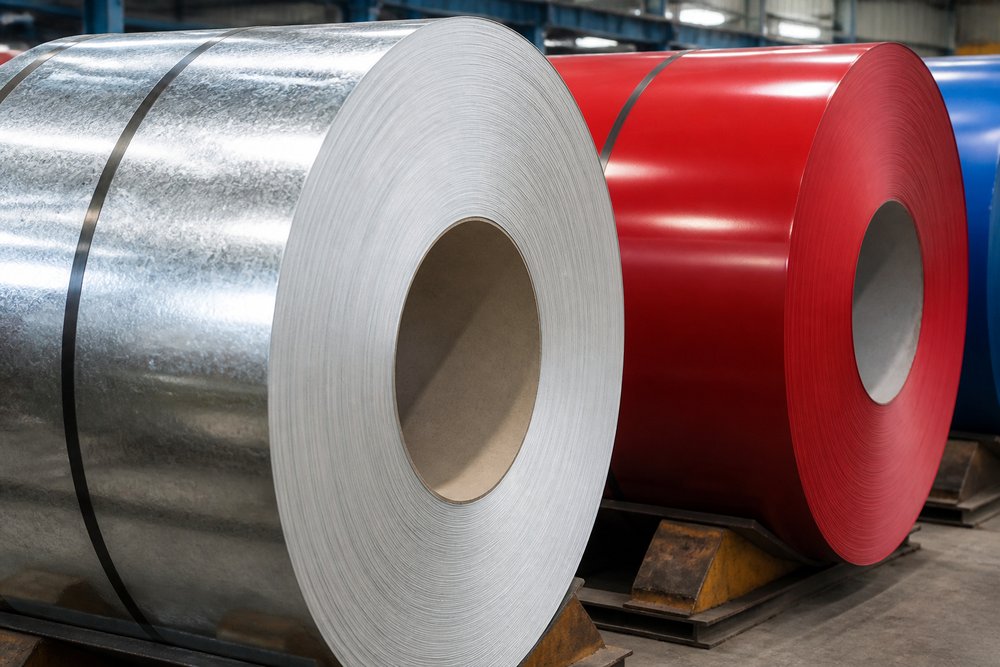
Hot-Dip Galvanized vs Galvalume vs Pre-Painted: What Matters
Hot-Dip Galvanized (HDG)
The most common coil for roll forming. Steel strip is dipped in molten zinc, creating a thick, durable coating. The standard coating weight for outdoor construction products is Z275, meaning 275 grams of zinc per square meter. HDG resists rust for decades in normal outdoor exposure. It costs less than galvalume and is available from mills worldwide.
Galvalume and Pre-Painted Options
Galvalume uses a zinc-aluminum alloy coating that offers better corrosion resistance than plain galvanized in certain environments, particularly coastal and industrial. Pre-painted coil has a primer and color coat applied to galvanized or galvalume substrate before roll forming. It eliminates the need for post-production painting and gives the finished product a consistent, warranty-backed color finish.
Coil Width and Thickness: Getting the Specs Right
Matching Coil Width to Your Machine
Roll forming machines are designed for a specific coil width range. Feeding a coil that is too wide jams the entry guides. Too narrow and the strip wanders, producing uneven flanges. The machine manual lists the minimum and maximum coil width. Stay within that range. Ordering coil slit to your exact width from the mill saves time and eliminates the need for in-house slitting.
Thickness Tolerance and Its Impact
Standard commercial tolerance for coil thickness is plus or minus 0.05 mm. A coil ordered as 0.50 mm may arrive anywhere from 0.45 mm to 0.55 mm. This variation affects how the metal flows through the rollers. Thicker material requires more forming force and increases tooling wear. Thinner material may not fill the roller profile completely. Consistent thickness from batch to batch is more important than the absolute number.
Why Coil Quality Determines Final Product Quality
Surface Defects That Ruin Finished Product
Coil with surface scratches, rust spots, or uneven coating will produce finished parts with the same defects. These cannot be fixed in the roll forming process. Before accepting a coil delivery, inspect the outer wraps for visible damage. Run a short test strip through the machine and check the formed profile for coating cracks or flaking at the bend lines.
Edge Condition and Camber
The edges of the coil strip should be clean and straight. Burred edges from poor slitting will scratch the roll forming tooling and produce rough-edged finished parts. Camber, or edge curvature along the strip length, causes the strip to track unevenly through the rollers. A camber of more than 3 mm per 3 meters can cause alignment problems and should be rejected.

Yield Strength and How It Affects Roll Forming
Why Yield Strength Matters
Yield strength is the stress at which steel begins to deform permanently. Roll forming works by bending the steel past its yield point at each roller station. Higher yield strength requires more forming force and more roller stations to achieve the same profile. Most construction-grade roll forming uses steel with yield strength between 230 and 350 MPa.
High-Strength Steel Considerations
High-strength low-alloy (HSLA) steels with yield strengths above 350 MPa are increasingly used for lightweight structural profiles. These require roll forming machines with heavier frames, larger diameter rollers, and more powerful drives. The tooling must be made from higher-grade tool steel to resist wear. If you plan to run high-strength steel, specify this upfront so the machine is designed for it.
Storage and Handling Before the Coil Hits the Line
Protecting Coils From Moisture and Damage
Steel coils must be stored indoors in a dry environment. Moisture trapped between coil wraps causes white rust on galvanized coating and red rust on exposed edges. Coils should be stored on their sides on padded cradles, never stacked directly on concrete. A forklift dent in the outer wrap can render several meters of coil unusable.
Inventory Management
Keep at least two weeks of coil inventory for each product SKU you run. Mill lead times can stretch to eight weeks during peak construction season. Running out of coil for a high-demand product means lost orders. Color-coated coils have even longer lead times because of the additional processing step. Plan your coil orders around your production schedule, not the other way around.
Metoform Raw Material and Auxiliary Fittings
Coil Compatibility Across All Machines
Metoform roll forming machines are designed to run industry-standard coil specifications from major mills. Each machine documentation includes the recommended coil width range, thickness tolerance, and material grade. The engineering team can advise on coil specifications for specific profiles and production volumes.
Auxiliary Equipment and Consumables
Metoform also supplies auxiliary fittings and consumables including decoilers, straighteners, and coil handling equipment. Having the coil handling equipment matched to the roll forming line ensures smooth material flow from coil to finished product.
Frequently Asked Questions
Galvanized steel is coated with zinc. Galvalume is coated with a zinc-aluminum alloy, typically 55% aluminum, 43.4% zinc, and 1.6% silicon. Galvalume offers better corrosion resistance than standard galvanized in coastal and industrial environments but costs more. Both are suitable for outdoor construction products.
Coil weight is determined by width x thickness x length x density of steel (7.85 g per cubic cm). A typical 1,250 mm wide, 0.50 mm thick coil at 5,000 kg yields approximately 1,020 meters of strip. Calculate your monthly production in linear meters and order coil weight accordingly.
Yes, with adjustments. Aluminum is softer than steel and requires less forming force. The roller gap may need adjustment. Aluminum also expands more with temperature changes, which affects dimensional stability. Tooling designed for steel can generally handle aluminum, but the reverse is not true.
For outdoor roof and wall panels, the standard is Z275 galvanized coating (275 g per square meter). In coastal or high-humidity environments, Z350 or Z450 may be specified. Pre-painted coil typically uses Z275 substrate with a 25-micron primer and 20-micron top coat.
Store coils indoors on their sides, supported by padded wooden or rubber cradles. Keep them off concrete floors. Maintain low humidity in the storage area. Never stack coils directly on top of each other. Rotate inventory so older coils get used first. Inspect outer wraps for damage upon delivery.
Contact Metoform to discuss a configuration that fits your market.

Product Recommendation


How can we assist you?
Tell us a bit more so we can route your request to the right expert.
Sign Up For Our Newsletter
Subscribe to our newsletter for product promos, news, and more.