
Strut Channel Roll Forming: What Every Steel Fabricator Should Know
Every commercial building has strut channel running through it. It holds pipes, ducts, cable trays, and conduit above ceilings and behind walls. Demand is steady, and the product is simple. But making it efficiently requires the right roll forming machine. This article covers what strut channel is, how it is made, and what to look for in a production line.
What Strut Channel Is and Where It Is Used
The Backbone of Commercial Construction
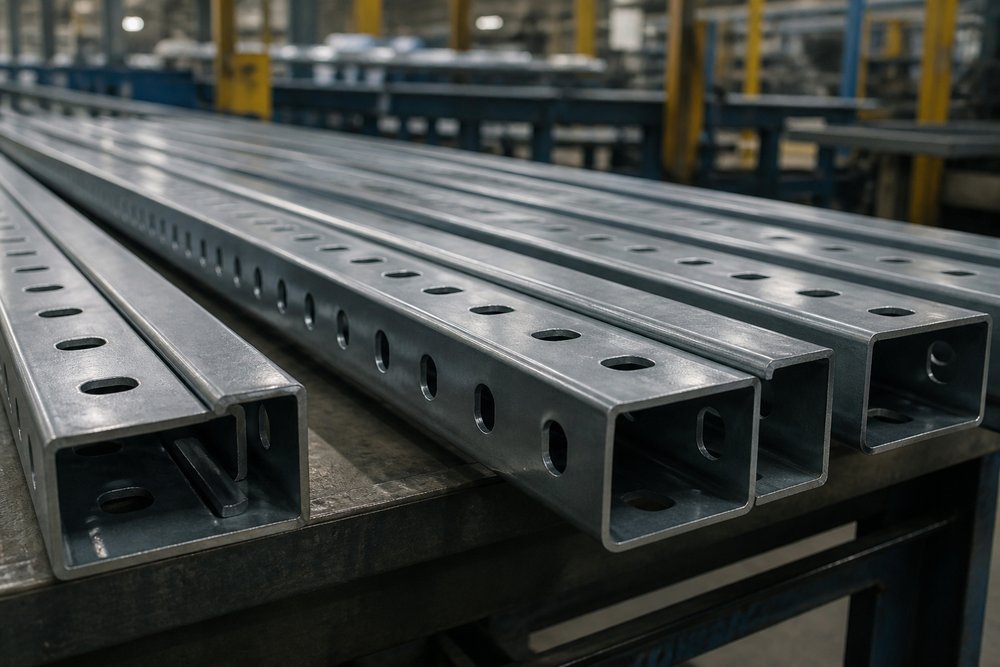
Strut channel, also called Unistrut or channel framing, is a standardized metal framing system. It consists of a U-shaped steel channel with inward-curving lips. Bolts, nuts, and brackets slide into the channel and lock anywhere along its length. Electricians use it to hang conduit. HVAC contractors use it to support ductwork. Plumbers hang pipe runs from it. It is everywhere in commercial and industrial buildings.
Why Demand Is Steady
Every new commercial building, warehouse, and factory needs strut channel. Renovation projects add more as systems are upgraded. The product does not become obsolete because building codes continue to require mechanical support systems. For a roll forming operation, strut channel offers a product with predictable year-round demand that does not depend on any single industry cycle.
How a Strut Channel Roll Former Works Step by Step
From Coil to Channel
A strut channel roll forming line starts with a steel coil mounted on a decoiler. The strip feeds through a straightener to remove coil set, then enters a series of roller stations. Each station progressively bends the flat strip into the U-channel shape with inward lips. After forming, a hydraulic punch press adds the mounting holes at specified intervals. A flying cutoff saw cuts the channel to length without stopping the line.
Speed and Automation Level
Entry-level lines run at 10 to 15 meters per minute. Fully automated lines with servo-driven punches and flying cutoff can reach 25 to 35 meters per minute. The speed difference matters most for high-volume operations running multiple shifts. For a job shop producing custom lengths in small batches, a slower line with manual length setting may be the more practical choice.
Punched vs. Unpunched Channel Production
When Punching Matters
Most strut channel is sold with pre-punched holes. The holes accept bolts and connectors without the installer needing to drill on-site. A hydraulic punching unit integrated into the roll forming line punches holes at precise intervals, typically 25 mm or 50 mm spacing. The punch tooling must be hardened to handle the continuous impact of high-speed production.
Selling Unpunched Channel
Some customers prefer unpunched channel for custom fabrication. It gives them flexibility to drill their own hole patterns. Producing unpunched channel is simpler and faster because the punching station can be bypassed. Some manufacturers offer both options from the same line by engaging or disengaging the punch unit as orders require.

Common Strut Channel Dimensions and Profiles
Standard Sizes by Market
The most common strut channel sizes are 41 mm x 21 mm and 41 mm x 41 mm. Larger profiles go up to 62 mm x 62 mm for heavy industrial applications. Wall thickness typically ranges from 1.5 mm to 2.5 mm for standard duty and up to 3.0 mm for heavy duty. The size range your machine can produce determines which customer segments you can serve.
Single vs. Multi-Size Machines
A dedicated single-size machine produces one profile at maximum efficiency. A multi-size machine can switch between two or three common sizes by swapping roller sets. The multi-size option costs more upfront but opens up additional revenue streams without buying a second line. Which approach makes sense depends on your market’s mix of demand.
Quality Checks That Matter for Strut Channel
Dimensional Tolerance and Straightness
Strut channel must fit standard connectors and brackets. If the channel is too wide or too narrow by even a millimeter, bolts will not slide properly and installers will reject the product. After forming, every batch should be checked with a go/no-go gauge. Straightness matters for long runs. A channel that curves visibly over a three-meter span creates installation problems and lost customers.
Galvanizing Quality
Most strut channel is made from pre-galvanized coil. The zinc coating protects against rust in indoor environments. Check the coating thickness with a paint thickness gauge. Standard commercial grade is Z275 (275 g per square meter of zinc). If the forming process scratches through the coating, those areas will rust. Well-maintained rollers with proper lubrication prevent coating damage.
Metoform Strut Channel Machine Options
Production-Ready Equipment
Metoform manufactures strut channel roll forming machines designed for continuous production. Lines are available in single-profile and multi-profile configurations with integrated hydraulic punching. Each machine is built on a rigid welded frame to maintain dimensional accuracy over years of operation.
Support and Service
Every Metoform machine ships with installation supervision, operator training, and a spare parts kit for the first year of production. The engineering team provides remote support for troubleshooting and can supply replacement rollers and punch tooling as needed.
Frequently Asked Questions
Strut channel has inward-curving lips designed to retain nuts and connectors anywhere along the channel. C purlins have outward-facing flanges and are structural members for roof and wall support. Strut channel is lighter gauge and used for mounting systems, not for structural framing.
Standard strut channel typically has slotted holes at 25 mm or 50 mm centers along the length. Some profiles have holes on the back face only, while others are punched on both the back and sides. The hole pattern is configured in the punching station tooling.
Yes, with the right tooling. Slotted channel has elongated holes instead of round ones, allowing more adjustment range. The punching station can be tooled for either hole type, and some machines can switch between round and slotted holes by changing the punch die set.
Most strut channel is produced from commercial-quality hot-dip galvanized steel, typically ASTM A653 grade with a minimum yield strength of 230 to 250 MPa. Pre-galvanized coil with a Z275 coating weight is standard for indoor use.
Speed depends on the line configuration and profile complexity. Basic lines run at 10 to 15 meters per minute. Fully automated lines with servo-driven punching and cutoff can reach 25 to 35 meters per minute, producing roughly 1,500 to 2,000 meters per eight-hour shift.
Contact Metoform to discuss a configuration that fits your market.


How can we assist you?
Tell us a bit more so we can route your request to the right expert.
Sign Up For Our Newsletter
Subscribe to our newsletter for product promos, news, and more.