
The Business Case for Sandwich Panel Production Lines
Sandwich panels are the fastest-growing segment in cold storage, industrial building, and clean room construction. The panels combine two metal skins with an insulated core and arrive at the job site ready to install. Making them in-house instead of buying from a third party can shift your margin structure entirely. This article walks through the economics of owning a sandwich panel production line.
What Sandwich Panels Are and Who Buys Them
The Product
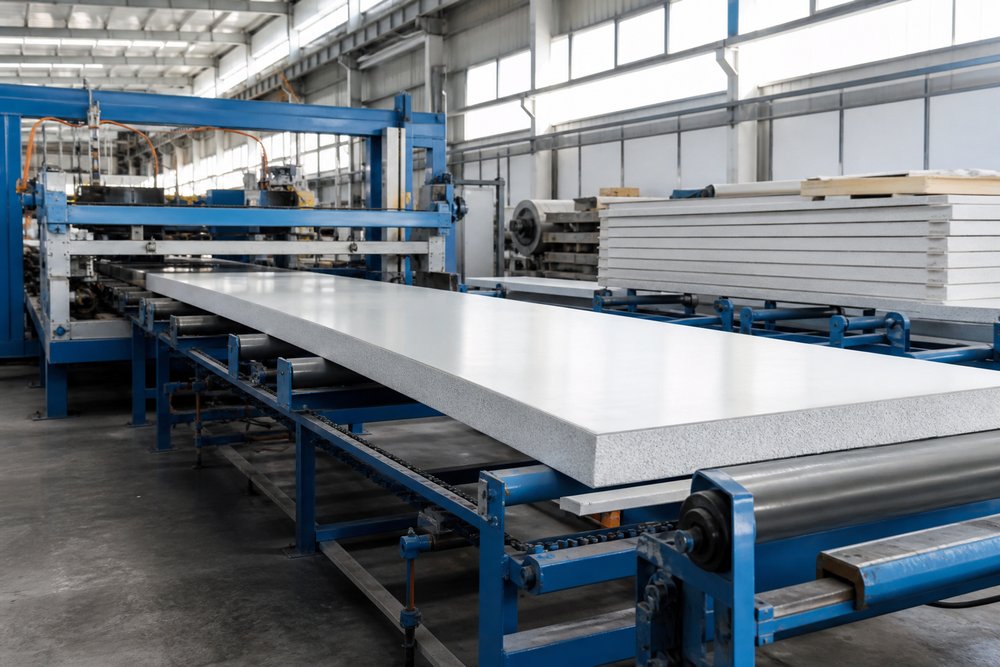
A sandwich panel consists of two metal face sheets, typically pre-painted galvanized steel 0.40 to 0.70 mm thick, bonded to a rigid insulation core. The core can be EPS foam, polyurethane foam, rock wool, or PIR. Panels are used for walls, roofs, and cold storage enclosures. They provide structural strength, thermal insulation, and a finished interior and exterior surface in one product.
The Buyer Profile
The main buyers are industrial building contractors, cold storage facility operators, clean room specifiers, and agricultural building companies. A single large warehouse can use 5,000 to 10,000 square meters of panels. Demand tracks commercial and industrial construction activity, which has been growing steadily in Southeast Asia, the Middle East, and Africa.
In-House vs. Outsourced Panel Production Costs Compared
The Outsourced Model
Buying finished panels from a third-party manufacturer typically costs 15 to 22 dollars per square meter for standard EPS-filled wall panels, depending on thickness and face material. On a 10,000-square-meter project, that is 150,000 to 220,000 dollars in panel costs. The buyer also pays freight, which for bulky insulated panels can add 10 to 15 percent to the landed cost.
The In-House Model
Making the same panels in-house reduces the per-square-meter cost to roughly 9 to 12 dollars for materials, labor, and overhead. On that same 10,000-square-meter project, the savings are 50,000 to 120,000 dollars. A sandwich panel line that costs 200,000 to 350,000 dollars can pay for itself in three to six projects. After that, the margin stays in your business.

How a Sandwich Panel Line Works
The Production Process
A sandwich panel line is a continuous production system. Top and bottom metal coils feed into the line from decoilers. The sheets pass through roll forming stations that create the panel profile. The insulation material is injected or laid between the sheets. The assembly passes through a heated press or curing oven, where the insulation bonds to the metal skins. A flying saw cuts panels to length.
Line Configuration Options
Entry-level lines produce EPS-filled panels at 3 to 5 meters per minute. Higher-capacity lines running polyurethane foam reach 6 to 10 meters per minute. The line can be configured for wall panels, roof panels, or both by changing the roller tooling. Some manufacturers offer dual-purpose lines that switch between panel types with a tooling change.
Market Demand Drivers for Sandwich Panels
Cold Storage Expansion
Cold storage construction is growing at 10 to 15 percent annually, driven by food supply chain modernization and pharmaceutical cold chain requirements. Sandwich panels are the primary building material for temperature-controlled warehouses. A single regional cold storage operator may build 50,000 square meters of new space per year.
Prefabricated Building Trend
Contractors increasingly prefer prefabricated panel systems over traditional brick-and-mortar or site-built insulated walls. Panels go up faster, require less skilled labor on-site, and provide better insulation performance. This trend favors local panel manufacturers who can supply panels cut to project dimensions with short lead times.
Capacity Planning: How to Size Your Line
Matching Line Speed to Market Demand
Calculate your expected annual panel production in square meters. If your market absorbs 100,000 square meters per year, a line running at 3 meters per minute producing 1.0-meter-wide panels needs roughly 560 operating hours per year at 70 percent efficiency. That is manageable on a single shift. If demand grows, adding a second shift doubles capacity without buying a second line.
Space and Utility Requirements
A sandwich panel line needs approximately 300 to 500 square meters of floor space for the production line, plus additional space for coil storage, finished panel storage, and material handling. Power requirements range from 80 to 150 kW depending on line speed and heating method. Plan the factory layout carefully because expanding the production area later is more expensive than building it right the first time.
Metoform Sandwich Panel Line Overview
Purpose-Built Equipment
Metoform manufactures EPS and PU sandwich panel production lines configured to customer specifications. Lines are available for wall panels, roof panels, and dual-purpose configurations. Each line includes decoilers, roll forming stations, insulation application, a curing system, and a flying cutoff saw in a coordinated production sequence.
Metoform provides complete support from factory layout planning through installation, commissioning, and operator training. The engineering team works with your production staff to optimize line speed and product quality during the ramp-up period.
Frequently Asked Questions
Explore the EPS and PU sandwich panel line for your facility.

Product Recommendation


How can we assist you?
Tell us a bit more so we can route your request to the right expert.
Sign Up For Our Newsletter
Subscribe to our newsletter for product promos, news, and more.