
Why Roofing Contractors Are Switching to On-Site Gutter Manufacturing
Every roofing contractor knows the frustration: gutters arrive bent, the longest section is two feet short, and the customer wants a color that was out of stock. More contractors are solving these problems by bringing gutter manufacturing to the job site with a mobile roll forming machine. It changes what they can offer, what they can charge, and how fast they can finish a job.
The Problem With Ordering Pre-Made Gutters
Five Problems, Every Job
First, gutters are bulky. A truck can carry only so many ten-foot sections, so long runs need multiple trips. Second, gutters get damaged in transit. A bent corner or dented face on a twenty-foot section means the whole piece is scrap. Third, standard lengths rarely match building dimensions exactly, so every run has a seam where two sections join. Fourth, color matching is a recurring headache when the supplier changes its coating formulation. Fifth, lead times stretch during peak construction season.
The Seam Problem
Every joint between gutter sections is a potential leak point. Over time, sealant degrades, thermal expansion works the joint loose, and water finds its way through. A gutter formed on-site in a single continuous length has zero seams from end to end. No joints means no leaks. Customers notice the difference and are willing to pay for it.
Transport Damage and Length Limitations
What Shipping Does to Gutters
Pre-made gutters travel from factory to distributor to contractor. Each transfer point adds handling, and each handling event adds risk of damage. The standard trucking length limit for most regions is 12 to 16 feet. Gutters longer than that require specialized transport or are cut short. The result is more joints per installation and more potential failure points.
The Mobile Solution
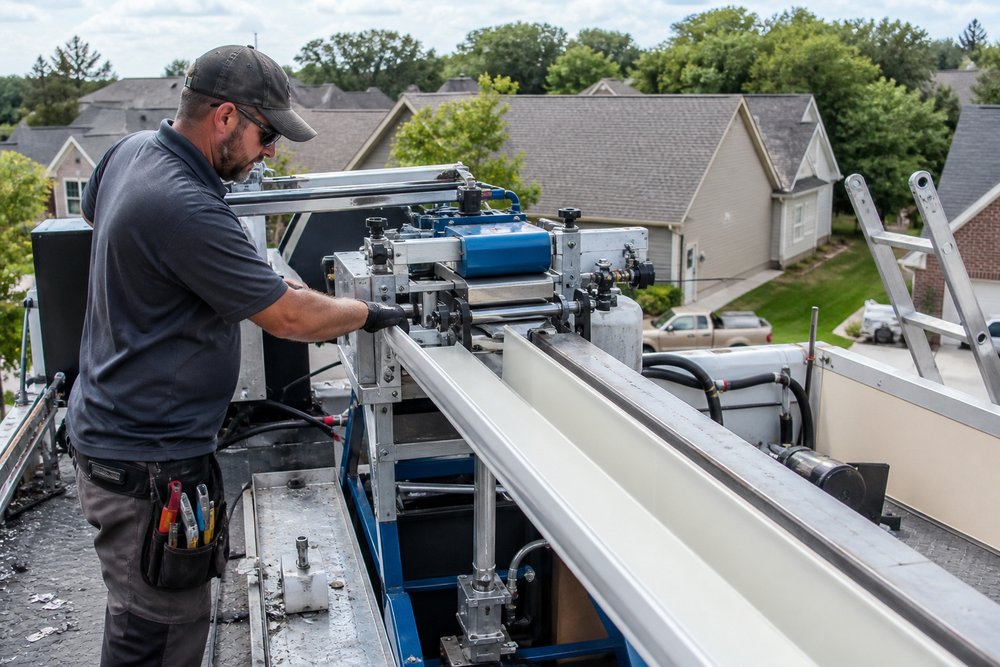
A mobile gutter machine mounted on a trailer travels to the job site with the crew. Coils of flat steel strip take up a fraction of the truck space that finished gutters would. One coil produces hundreds of feet of gutter. The machine forms the gutter profile directly from the coil in a continuous piece cut to the exact length of each building face.
What an On-Site Gutter Machine Lets You Offer
Continuous-Length Gutters
The headline benefit is continuous gutters in any length up to the coil capacity. A building with a 60-foot eave gets a single 60-foot gutter. No seams, no joints, and no leak points. This is a premium product that commands a premium price. Homeowners and commercial property managers both recognize the value.
Same-Day Color Matching
Mobile gutter machines can run pre-painted coil in dozens of standard colors. The contractor carries coils in the most popular colors and can match the gutter color to the roof, trim, or window frames on the spot. There is no ordering, waiting, or color mismatch complaint weeks after installation.

Half-Round vs. Box vs. K-Style Gutters
K-Style: The North American Standard
K-style gutters have a flat back, a decorative front profile that resembles crown molding, and a flat bottom. They are the most common residential gutter type in North America. A 5-inch K-style gutter handles most residential applications. A 6-inch version serves commercial buildings and larger roofs.
Half-Round and Box Gutters
Half-round gutters have a semicircular profile and are common on historic buildings and high-end residential projects. Box gutters are rectangular and used on commercial and industrial buildings with flat or low-slope roofs. Some mobile gutter machines can produce both K-style and half-round profiles by changing the roller set.
How Mobile Roll Forming Changes Job Site Economics
Faster Completion, Faster Payment
With a mobile gutter machine on-site, the crew measures, forms, and installs gutters in one continuous workflow. There is no waiting for delivery, returning damaged sections, or rescheduling because the wrong color showed up. A two-person crew can produce and install 200 to 300 feet of gutter in a day. Jobs finish faster, and invoices go out sooner.
New Revenue From a Service You Already Offer
Most roofing contractors already install gutters. The difference between buying them and making them is the profit margin on the gutter itself. That margin, typically 40 to 60 percent, stays in the business instead of going to the gutter supplier. Over a season of 50 roofing jobs averaging 150 feet of gutter each, the margin on 7,500 feet of gutter covers most or all of the machine cost.
Metoform Gutter Machine Capabilities
Mobile and Stationary Options
Metoform manufactures gutter roll forming machines in both mobile trailer-mounted and stationary factory configurations. Mobile units are compact, self-contained, and designed for daily transport to job sites. Stationary units are larger, faster, and suited for high-volume production feeding multiple installation crews.
Multi-Profile Flexibility
Metoform gutter machines can be configured for K-style, half-round, and box profiles. Quick-change roller sets allow switching between profiles without extensive downtime. Each machine is tested at the factory before shipping.
Frequently Asked Questions
Yes, many gutter machines can produce both K-style and half-round profiles by changing the roller set. The changeover typically takes 30 to 60 minutes. Some machines are dedicated to a single profile for maximum production speed.
A trailer-mounted gutter machine typically takes 15 to 30 minutes to set up at the job site. This includes leveling the trailer, connecting power, loading the coil, and running a test piece to verify the profile.
A mobile gutter machine typically pays for itself within one to two seasons of regular use. For a roofing contractor doing 40 to 50 jobs per year with average gutter runs of 150 feet, material savings alone cover the machine cost. The additional revenue from offering continuous gutters as a premium service accelerates payback.
Gutter machines typically run pre-painted galvanized steel, galvalume, aluminum, and copper coil. Aluminum is lighter and easier to form. Copper requires more forming force and specialized tooling. Standard machines are designed for steel and aluminum.
Corners and end caps are fabricated separately from pre-cut flat stock or purchased as pre-made fittings. The gutter machine produces the straight runs only. Most contractors keep a stock of corner fittings and end caps on the truck to match the gutter profile and color.
Contact Metoform to discuss a configuration that fits your market.


How can we assist you?
Tell us a bit more so we can route your request to the right expert.
Sign Up For Our Newsletter
Subscribe to our newsletter for product promos, news, and more.