
Why Steel Fabricators Are Adding CNC Folding to Their Production Lines
Manual press brakes have been the workhorse of sheet metal bending for decades. They are simple and reliable, but they are the bottleneck in a growing number of fabrication shops. As order volumes increase and part geometries get more complex, manual bending cannot keep up. CNC folding machines are appearing in more fabrication lines as the solution: they fold faster, hold tighter tolerances, and handle part geometries that a manual press brake cannot.
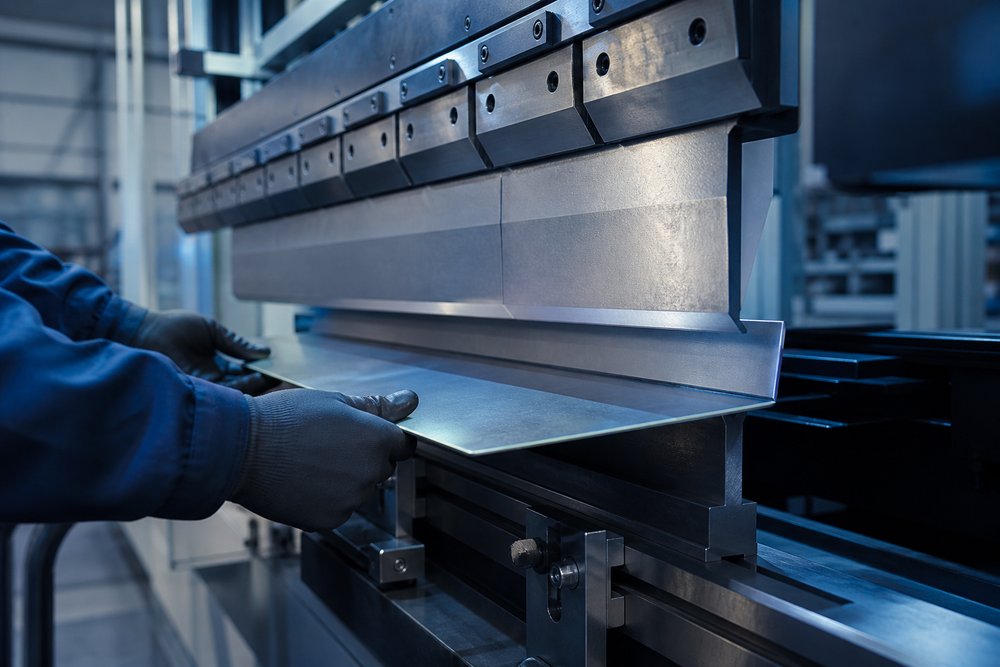
The Limitations of Manual Bending in a High-Volume Shop
The Operator Is the Bottleneck
On a manual press brake, every bend depends on the operator: positioning the sheet against the back gauge, triggering the stroke, checking the angle with a protractor, repositioning the part, and rechecking. A skilled operator can achieve good results on a simple part. But with six bends in different directions or an order for 500 identical pieces, human positioning speed and fatigue limit cycle time. The first 20 parts may hit tolerance, while the next 480 drift as the operator tires.
Part Handling for Large and Heavy Sheets
Manual press brakes struggle with large sheets. A 3-meter sheet weighing 40 kilograms needs two people to position and flip between bends, or a costly material-handling system. It must be supported through the full range of motion as it rises with the punch, creating injury risk when sheets slip or tip. On a CNC folder, the sheet sits flat on the table and the folding beam moves up. One operator can handle sheets that would need two on a press brake, which determines profitability for heavy-gauge enclosure, cabinet, and cladding work.
What a CNC Folding Machine Brings to the Floor
How CNC Folding Works Differently From Press Braking
A press brake pushes a punch into a V-shaped die, lifting the sheet and creating the bend through tool geometry. A CNC folding machine holds the sheet flat with a clamping beam and swings a folding beam up over the clamping edge. Its stroke controls bend angle rather than tool geometry. The machine can produce any angle from zero to 180 degrees without changing tooling. One folding and clamping beam set can fold thousands of parts and angles; the bend sequence is programmed, not tooled.
Automatic Tool Change and Programmable Bend Sequences
A CNC folding machine stores bend programs digitally. The operator loads the sheet against the back gauge, then the machine executes the sequence: clamp, fold to angle, unclamp, reposition, and repeat. A part with eight alternating-direction bends completes in one automated cycle without manual flipping. For the next part, the operator selects a new program and the machine adjusts back gauge position and fold angle automatically. Changeover takes seconds rather than the 20 to 60 minutes of press-brake die changes, which can double daily output for shops running many part numbers.
What You Can Make With CNC That Manual Cannot
Multi-Direction Bends in a Single Setup
A manual press brake bends in one direction; opposite bends require flipping the sheet, and tabs that go both ways may require special tooling or multiple operations. A CNC folder bends both directions without flipping. It can program an upward fold on one edge, a downward fold on the next, and a hem on the third in one sequence. Complex edge profiles, including electrical cabinet panels with returns on all four sides and internal stiffening ribs, become practical at production volumes.
Hemming, Radius Bending, and Closed Profiles
Press-brake hemming requires a two-stage process and different tooling. A CNC folder can fold to an acute angle and flatten in one programmed sequence. Radius bends use a series of small incremental folds to approximate a curve. Closed profiles, such as square tubes folded from flat sheet, are possible because the clamping beam holds the workpiece while the folding beam accesses the forming edge from the side. For shops that need these capabilities, the folder replaces manual welding and grinding operations that cost more in labor than the machine payment.

Accuracy and Repeatability: Why It Matters at Scale
Bend Angle Consistency Across a Production Run
Manual bend angle depends on an operator’s compensation for material spring-back, which varies by material and coil batch. Angle variation of half a degree to a full degree stacks up in assemblies, causing gaps and misaligned fastener holes. A CNC folder checks each bend with an angle measurement system and adjusts the folding beam stroke in real time. It automatically compensates for spring-back and can hold angle consistency within 0.2 to 0.3 degrees across a run.
Dimensional Accuracy in Complex Assemblies
The back gauge positions the sheet for each bend with an accuracy of 0.1 mm or better. Cumulative error is a fraction of that on a manual brake. When folded panels must bolt or weld together, this eliminates fitting and adjustment: the panels go together straight off the folder instead of requiring grinding, enlarged holes, and forced alignment.
How CNC Folding Integrates With Roll Forming Workflows
Folded End Details on Roll-Formed Profiles
Roll forming produces long, continuous profiles with a constant cross-section, but many finished products need folded end details. A CNC folder adds end tabs, mounting flanges, and closure plates. For example, a roll-formed C-channel can be cut to length and transferred to the CNC folder, where both ends become mounting brackets in seconds without welding separate brackets.
Panel Production: Roll Forming for Structure, Folding for Enclosures
Roll forming commonly produces frame members such as purlins, studs, channels, and decking; CNC folding produces access panels, equipment covers, electrical enclosures, and architectural cladding. The machines feed the same assembly line, giving modular buildings and industrial equipment housings both structural and enclosure capabilities.
Metoform CNC Folding Machine Capabilities
Machine Range and Specifications
Metoform supplies CNC folding machines for enclosures, panels, cabinets, and architectural components. Working lengths range from 1,250 mm to 4,000 mm. Mild-steel capacity is 0.5 mm to 3.0 mm, with reduced capacity for stainless steel and aluminum. Bend angles are programmable from zero to 180 degrees with automatic spring-back compensation. Standard features include a servo-driven folding beam, programmable multi-stop back gauge, automatic tool clamping, and touchscreen control with program storage. Options include automated loading and unloading, robotic handling, and offline programming.
Training, Integration, and Support
Every Metoform CNC folder ships with on-site installation, operator training, and production startup support. Training covers programming, tool setup, bend-sequence optimization, and routine maintenance. Metoform supports integration with upstream roll forming lines and downstream assembly stations, with remote diagnostics, on-site service, and consumable tooling available throughout the machine’s operating life.
Frequently Asked Questions
A press brake pushes a punch into a die and lifts the sheet. A CNC folder holds the sheet flat and swings a folding beam up. CNC folders eliminate manual handling, bend in both directions without flipping, and hold tighter consistency.
Standard CNC folders handle 0.5 mm to 2.0 mm mild steel. Heavy-duty models bend up to 3.0 mm. Stainless capacity is approximately 60 to 70 percent of the mild-steel rating, while aluminum capacity is typically equal to or slightly higher.
Basic four-to-six-bend parts take 15 to 30 minutes at the control. Complex parts with 10 or more bends, hems, and radii may take one to two hours initially. Stored programs are recalled instantly, and offline software allows programming while the machine runs.
For small batches of simple profiles, yes. A folder can produce channels, Z-profiles, and hat sections without dedicated roll tooling. Above roughly 500 pieces or 1,000 linear meters, roll forming is faster and lower cost per piece. CNC folding complements roll forming for short runs and complex geometries.
Daily tasks include cleaning surfaces and checking alignment and back gauge accuracy. Weekly tasks include lubricating guides and pivots and checking hydraulic fluid. Monthly tasks include inspecting clamping inserts, calibration, and connections. Annual work includes an oil change, full calibration, and replacement of wear items.
Contact Metoform to discuss a configuration that fits your market.


How can we assist you?
Tell us a bit more so we can route your request to the right expert.
Sign Up For Our Newsletter
Subscribe to our newsletter for product promos, news, and more.