
Floor Decking Machines: What Every Steel Fabricator Should Know
Steel floor decking is the invisible backbone of modern commercial construction. Every multi-story steel building, every warehouse mezzanine, and every parking garage relies on corrugated steel deck panels to support concrete floors. If your fabrication shop is looking at floor decking as a new product line, the machine you choose determines your capacity, your product range, and your margin.
Metoform manufactures floor decking roll forming machines for steel fabricators worldwide. This guide covers what you need to know before you invest.
What Floor Decking Is and Why It Matters in Steel Construction
Composite vs Non-Composite Decking
Floor decking comes in two categories. Composite deck uses embossed patterns on the steel surface that mechanically bond to the concrete slab above it. The steel and concrete act together as a single structural element. This lets engineers reduce the beam size and steel tonnage in the building frame, which saves money on every floor. Non-composite deck, also called form deck, simply holds the wet concrete in place until it cures. The steel does not contribute to the slab strength after the concrete hardens. Form deck is lighter gauge and cheaper per square meter. Composite deck costs more per sheet but saves money in the overall structure.
Where Floor Decking Goes in a Building
Floor deck panels span between the structural steel beams on each floor level. The deck is installed first. Workers lay out the panels, fasten them to the beams, and then pour the concrete slab on top. In a typical 10-story steel building, floor deck accounts for thousands of square meters of steel product. The volume per project makes floor deck an attractive product line for roll forming operations. One building project can represent weeks of steady production for a single machine. Repeat orders from the same structural steel contractors drive year-round utilization.
How a Floor Decking Roll Former Works
The Forming Sequence Step by Step
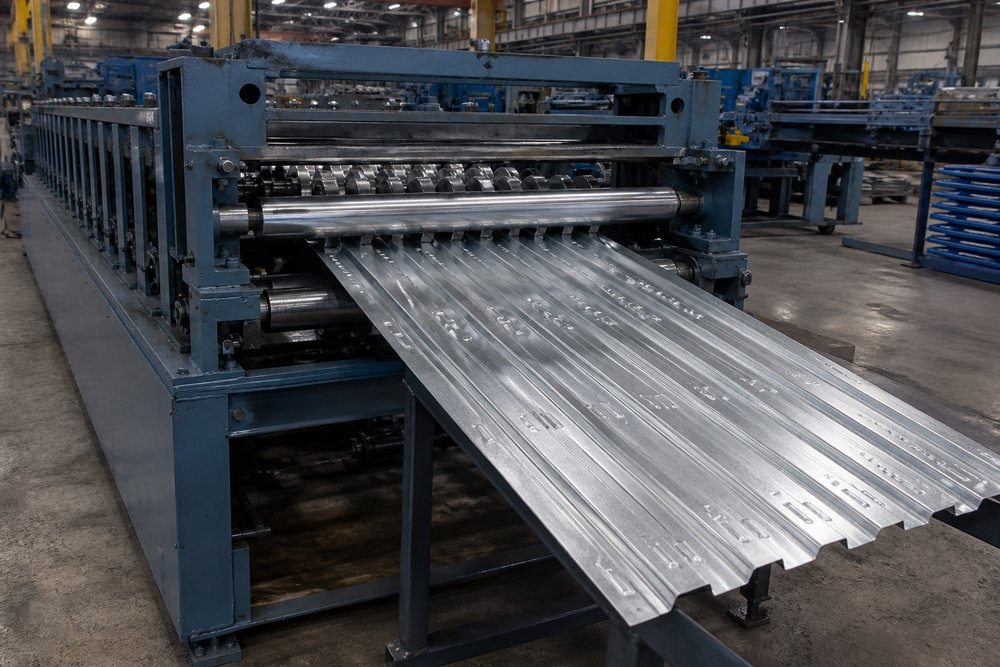
A coil of galvanized steel strip feeds into the machine from a powered decoiler. The strip passes through a leveling section that removes coil set and ensures the steel enters the forming rollers flat. From there, the strip moves through a series of roller stations. Each station adds a little more profile depth. By station ten or twelve, the flat strip has become a fully formed deck panel with ribs, returns, and side laps. The number of stations depends on the profile depth and complexity. A deep composite deck with embossed ribs may need 18 to 24 stations. A simple form deck needs fewer.
Embossing, Punching, and Cutoff
For composite deck, an embossing unit presses indentations into the steel at specific points on the ribs. These embossments create the mechanical bond between steel and concrete. Without them, the steel and concrete do not lock together and the structural engineer cannot count the deck in the composite design. After embossing, in-line punching may add holes for shear studs or service penetrations. At the end of the line, a flying cutoff shear slices each panel to the programmed length. The machine does not stop between panels. Production is continuous, with the cutoff traveling with the steel during the cut and returning to position for the next piece.
Types of Floor Deck Profiles and Their Uses
Common Profile Shapes and Dimensions
The most widely used floor deck profiles are dovetail, trapezoidal, and re-entrant. Dovetail profiles have a narrow top opening that widens at the base. The shape mechanically locks the concrete in place, which is useful for composite action. Trapezoidal profiles have wide, flat-bottom ribs with angled sides. They cover more area per sheet and use less concrete fill. Re-entrant profiles, sometimes called dove-in profiles, have inward-sloping side walls that grip the concrete. Each shape suits different span lengths and slab thicknesses. Typical profile depths range from 38mm form deck to 80mm or more for long-span composite deck. Panel widths are usually 600mm to 900mm in cover width.
Matching the Machine to the Profiles You Sell
A single-profile machine makes one deck shape in one depth. It costs less and produces faster between changeovers. A multi-profile machine can switch between two or three deck shapes by changing roller cassettes. The changeover takes one to two hours depending on the machine design. If your market calls for both 50mm composite deck and 38mm form deck, a multi-profile machine lets you serve both without buying two separate lines. The trade-off is higher upfront cost and more tooling storage. Most fabricators start with the profile that represents 80 percent of their market and add tooling for a second profile once the first line is generating steady revenue.
Production Speed and Capacity Planning
Meters per Minute and What It Means for Your Output
A floor deck roll forming machine runs at 10 to 25 meters per minute depending on the steel gauge and profile depth. Thinner gauge form deck runs faster. Heavier composite deck with embossing runs slower because the embossing unit cycles at a fixed rate. At 15 meters per minute, a machine produces 900 meters of deck per hour of run time. In an eight-hour shift with 80 percent uptime, that is about 5,700 meters, or roughly 1,900 standard 3-meter panels. That output can supply deck for a full floor of a mid-rise building in a single shift.
Planning for Real-World Uptime
The headline speed number is not the same as real production. Coil changeovers take 15 to 30 minutes. Profile changes between batches take one to two hours. Routine maintenance, tooling inspection, and occasional jam clearing chip away at run time. A realistic uptime target for a well-maintained single-profile line is 75 to 85 percent. For a multi-profile line with frequent changeovers, plan for 60 to 70 percent uptime. Use these numbers in your capacity planning, not the theoretical maximum speed. A machine that produces 2,000 panels per shift on paper will produce 1,400 to 1,700 in practice. Size your order pipeline accordingly.

Quality Standards for Structural Decking
Steel Deck Institute (SDI) Requirements
In North America, floor deck quality is governed by the Steel Deck Institute. SDI publishes dimensional tolerances, material specifications, and testing standards that every deck manufacturer must follow. Key requirements include minimum steel yield strength, profile depth tolerance of plus or minus 1.5mm, rib spacing accuracy, and embossment depth for composite deck. Buyers, especially commercial contractors and structural engineers, expect deck that meets SDI standards as a baseline. Non-compliant deck will be rejected on site. The machine must hold these tolerances consistently across thousands of panels. Roll pass design, roller surface hardness, and machine frame rigidity all contribute to holding tolerance over time.
Coating, Thickness, and Traceability
Floor deck steel is typically galvanized to G60 or G90 coating weight. Heavier coatings are specified for humid or coastal environments. The steel grade is usually ASTM A653 Grade 33 or Grade 50 for structural applications. Each coil that enters the machine should have a mill test report showing the heat number, chemistry, yield strength, and coating weight. Your customers may ask for these reports as part of the project submittal package. A proper production tracking system links each panel batch to the coil that produced it. If a quality issue arises on site, you need to trace it back to the source coil within minutes, not days.
Metoform Floor Decking Machine Overview
Machine Capabilities
Metoform builds floor deck roll forming machines for form deck and composite deck profiles in gauge ranges from 0.75mm to 1.5mm. Machines are available in single-profile and multi-profile configurations with quick-change roller cassettes. Standard features include powered decoiler with tension control, in-line embossing for composite profiles, flying cutoff shear with length programming, and automatic stacking at the outfeed. Profile depths from 38mm to 80mm. Panel cover widths from 600mm to 900mm.
Support and Training
Every Metoform floor deck machine ships with on-site installation, operator training, and a production startup program. We train your operators on coil loading, machine controls, profile changeover, embossing calibration, and routine maintenance. Our service team provides remote troubleshooting and on-site support throughout the machine’s operating life. We also supply replacement roller sets, embossing tooling, and shear blades as consumable items.
Metoform Floor Decking Solutions
Metoform manufactures floor deck roll forming machines for steel fabricators and building product manufacturers worldwide. Our machines produce form deck and composite deck profiles to SDI quality standards with in-line embossing, automatic cutoff, and quick-change tooling options.
Discuss Your Production Needs
Talk with Metoform about a configuration that fits your materials, profile requirements, and production goals.
Frequently Asked Questions
Floor decking is designed to support a concrete slab and live loads from people, furniture, and equipment. It is typically thicker (0.75mm to 1.5mm) and deeper (38mm to 80mm) than roof decking. Roof decking supports only the insulation, membrane, and occasional maintenance loads. It uses thinner gauge steel (0.4mm to 0.7mm) and shallower profiles. Floor deck often includes embossing for composite action. Roof deck does not.
Form deck typically uses 0.75mm to 1.0mm galvanized steel. Composite deck for structural applications uses 1.0mm to 1.5mm. The exact thickness is specified by the structural engineer based on the span, slab thickness, and design loads.
Yes. Multi-profile machines with interchangeable roller cassettes can switch between dovetail, trapezoidal, and form deck profiles. The changeover requires swapping the cassette and adjusting the embossing unit. This typically takes one to two hours. Single-profile machines cost less but produce only one deck shape.
Structural floor deck must pass bending tests, shear bond tests for composite deck, and dimensional checks per SDI standards. The testing is usually done during product qualification and re-tested when changing steel suppliers or coil gauges. Metoform provides testing support as part of the machine commissioning process.
A standard floor deck roll forming line takes four to six weeks from arrival at your facility to full production. This includes machine placement and leveling (one week), electrical and hydraulic connections (one week), roller installation and alignment (one week), and operator training plus trial production (one to two weeks). More complex multi-profile lines may add one to two weeks.
Explore the Explore floor decking roll forming machines for your facility.


How can we assist you?
Tell us a bit more so we can route your request to the right expert.
Sign Up For Our Newsletter
Subscribe to our newsletter for product promos, news, and more.