
Why Steel Fabricators Are Bringing Guardrail Production In-House
Highway guardrail production has long been the domain of a few large suppliers. Steel fabricators and mid-size manufacturers typically bought rails from these suppliers and focused on installation. That model is shifting. More fabricators are investing in their own guardrail roll forming machines for shorter lead times, lower per-unit costs, and better control over project schedules.
The Problem With Ordering Guardrails From Third Parties
Long Lead Times That Delay Projects
Ordering guardrails from a large supplier means waiting. Standard lead times for highway guardrail range from four to twelve weeks depending on the supplier’s backlog and order size. For a contractor building a 50-mile highway section, a twelve-week guardrail delay pushes the entire project timeline. Missed deadlines trigger penalties.
Freight Costs on Heavy Steel Products
Guardrails are heavy. A standard W-beam rail section weighs about 38 to 49 pounds per linear foot depending on gauge and coating. Shipping full truckloads across states or provinces adds thousands of dollars to every project. These freight costs are not fixed: fuel surcharges and driver shortages push them higher each year. The fabricator pays both the product markup and the transport markup.
What Changed in the Guardrail Supply Chain
Steel Tariffs and Material Sourcing
Trade policy changes over the past decade have reshaped steel supply chains. Tariffs on imported steel raised costs for guardrail suppliers that rely on foreign coil. These costs pass through to fabricators. Price instability makes project bidding unpredictable; a quote profitable at bid time can become a loss by the time steel arrives.
Infrastructure Spending and Regional Demand
Government infrastructure programs in North America, Europe, and Asia have increased highway construction and renovation spending. This increases guardrail demand. Regional suppliers cannot always keep up, and fabricators in active construction zones face allocation limits. An in-house machine eliminates the allocation problem: you produce what you need when you need it.
How an In-House Roll Former Changes the Math
Per-Unit Cost Comparison
Buying W-beam guardrail from a supplier costs roughly 3.50 to 5.50 dollars per linear foot depending on gauge and coating specification. Raw coil steel for the same rail runs about 1.20 to 1.80 dollars per linear foot. The difference is the supplier’s manufacturing margin, freight, and handling costs. An in-house machine captures most of that difference. After labor, electricity, and machine amortization, net savings range from 1.00 to 2.50 dollars per linear foot.
Margin Recovery Across Project Volume
On a 50-mile project using two-lane guardrail on both sides, you need roughly 528,000 linear feet of rail. At a net saving of 1.50 dollars per foot, the in-house approach saves 792,000 dollars. That pays for the machine in one project. Smaller fabricators with steady monthly volume recover the investment over 12 to 24 months. The math shifts further in your favor as steel prices rise.

Two-Lane vs. Three-Lane Guardrail Profiles
W-Beam for Standard Highways
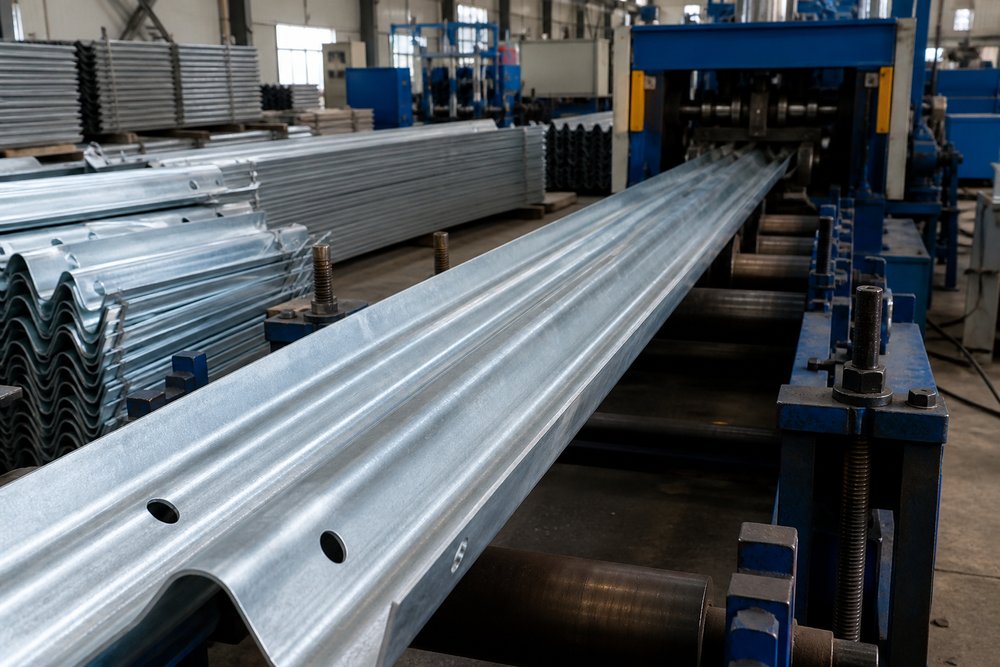
The W-beam profile is standard for two-lane highways and most secondary roads. It forms a shallow W shape from 12-gauge or 10-gauge steel, typically 12 inches wide. Roll forming machines produce W-beam at 15 to 25 meters per minute. The profile is simple, but its gauge thickness requires a sturdy machine frame and sufficient motor power.
Thrie-Beam for High-Speed and Multi-Lane Roads
Three-lane highways and high-speed corridors often use thrie-beam guardrail. The thrie-beam profile adds a third corrugation for greater impact resistance. It uses the same gauge range as W-beam but has a wider forming width, typically 20 inches. Machines capable of both profiles cost more but give fabricators access to both market segments. If your region specifies thrie-beam for Department of Transportation projects, a dual-profile machine is the right choice.
Installation Time Comparison: Purchased vs. Self-Made
Logistics Coordination vs. Direct Control
When you buy guardrails, you coordinate delivery schedules with the supplier, trucking company, and installation crew. A delay at any point cascades. When you make guardrails in-house, production feeds directly into the installation schedule. You run the machine based on the crew’s daily capacity. No third-party coordination means fewer delays.
Just-in-Time Production Reduces Site Storage
Job sites with purchased guardrails need secure storage for large steel shipments that may sit for weeks before installation. In-house production enables just-in-time delivery. The crew gets exactly the rails needed for the day or week. Site theft and weather-damage risks drop. Project managers report smoother workflows when guardrail supply matches installation pace.
Metoform Guardrail Machine Capabilities
Metoform guardrail roll forming machines produce W-beam and thrie-beam profiles in material from 10 to 14 gauge. The machines handle strip widths up to 600 mm with production speeds to 20 meters per minute. PLC control stores multiple profile recipes. Hydraulic punching and servo-driven cutoff ensure consistent hole positioning and length accuracy. Metoform brings 15 years of roll forming experience and 63 patents to every machine build.
Frequently Asked Questions
Fabricators with steady project volume recover their investment in 12 to 24 months. A single large highway project can pay for the machine on the first job. ROI depends on local steel costs and the supplier pricing you currently pay.
Standard machines produce W-beam profiles for two-lane roads and thrie-beam profiles for three-lane highways. Some machines also produce box-beam and industrial guardrail profiles. Dual-profile machines switch between W-beam and thrie-beam with a roller cassette change.
Standard highway guardrail uses 12-gauge steel, measuring about 2.7 mm thick. Heavy-duty applications and some state DOT specifications call for 10-gauge at about 3.4 mm. The machine must be rated for the thickest gauge you plan to run.
Many machines can run both types with a tooling change. Highway guardrails follow DOT specifications with specific profile dimensions. Industrial guardrails for warehouses and parking structures use similar forming principles but different profiles and lighter gauges. Confirm dual-use capability with the manufacturer.
Highway guardrail products in the United States must meet AASHTO M180 specifications. Each state DOT may have additional requirements. International markets follow their own standards, such as EN 1317 in Europe. Confirm that your machine can produce certified profiles for your target market.
Contact Metoform to discuss a configuration that fits your market.


How can we assist you?
Tell us a bit more so we can route your request to the right expert.
Sign Up For Our Newsletter
Subscribe to our newsletter for product promos, news, and more.